Growing up, my early childhood was filled with quarrels and fights that felt extreme. I was around people who weren’t who they seemed to be – who changed depending on the situation. As a child, it was deeply confusing. I carried hurt that wasn’t mine to carry.
What developed for me was this: any kind of disharmony meant panic. If someone had issues with my intentions, I would think that was the end. I could not be close to them anymore.
So, I lived between two extremes. Sometimes I’d give in completely, bending backwards to keep someone happy, losing myself to keep the peace. Other times, when I finally couldn’t take it anymore, I’d have to cut people off completely. Both came from the same fear – that disharmony was something dangerous, something to guard against.
Growing up, I’m realizing something.
I am grateful to have people who love me. Here’s what I realize: everyone is different. We’re bound to clash sometimes, to not see eye to eye. Having disagreements is normal – it’s even healthy to voice them. The love stays despite them. Feeling confident in that – not apologetic or angry about it – changes everything.
When disagreements come up now, I can actually say what I feel. “I see this differently” or “That hurt me.” Being able to say that – being honest like that – feels like a privilege.
I’m also learning to listen – really listen – to their point of view. That feels like honoring the relationship – making room for both our truths.
This extends beyond just disagreements. Any disharmony – tension, misunderstandings, different needs – doesn’t have to send me into panic anymore. I can stay present with it, notice when I’m overthinking, and come back to what’s actually happening. I can navigate it without losing myself or cutting people off.
I can forgive people from the past, and sometimes that forgiveness includes keeping distance – respecting what’s healthy for me. I can have honest conversations with people who can meet me there. I’m no longer swinging between those extremes.
I’m grateful for this shift. I’m learning that disagreement doesn’t have to mean the end. It can be a chance to truly see each other.
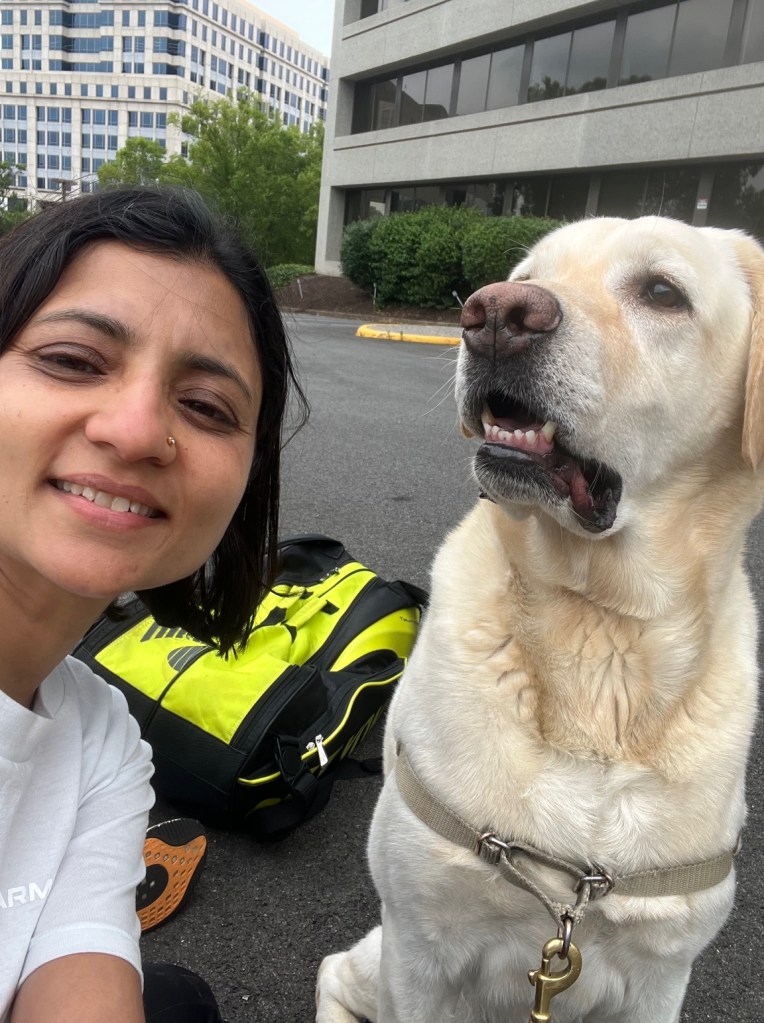
Tuffy, my golden lab, my companion for nine years, taught me something I’m still learning – how to live in the moment, how to love without conditions, how to be childlike without being self-conscious. His recent passing still feels like disbelief. It still feels like he’s gone to daycare while we’re on vacation.
This is what life is teaching us, I feel – to live like dogs do. Fully present, fully joyful, fully here.
With humans, I can’t be that way. I hold back. I perform. I worry about how I’m perceived. But with Tuffy? I could be silly. I could talk in that voice I use only for dogs, sing songs that made no sense, play games that were just ours. I could sit on the floor with him and forget about everything else.
He brought out the childlike part of me I thought I’d lost.
Tuffy didn’t need me the way I needed him. He was content. Emotionally mature. He trusted me. He didn’t need constant affection or reassurance – he just wanted to be near. I was more of a “Velcro” human to him. I’d put his bed wherever I was working, wherever I was doing things. He slept on his bed. I would just feel happy looking at him and calling out to him every now and then. In response, Tuffy would open his eyes or wag his tail, as if to say he loved me too.
And somehow, that was everything for me.
I remember how excited he’d get when I’d take him for walks, how happy he would be to welcome me every time I opened the front door and walked in. He loved bringing his toys to me and to play with him.
And I remember the last time.
Even when he was in pain – on what would be his last visit to the ER, though we didn’t know it then – he waited for me in the garage. My husband was walking with him toward the car, and I had to go back to get something. Tuffy stopped and turned to look at me. He wouldn’t budge. He turned back, waiting for me, looking out for me despite being in pain. I find that so emotional – his love for me, even in that moment. It was a habit he had. He wanted all family members to walk together with him. Not one ahead, not one behind. He found such joy in that togetherness.
What Tuffy taught me goes beyond the grief. He showed me what it means to live in presence – to find joy in simple things, to simply love, to trust without needing proof, to be fully here in each moment.
That’s the lesson. That’s what I carry forward.
Thank you, Tuffy, for teaching me how to live. For showing me what unconditional love looks like. For bringing out the best, most childlike, most joyful parts of me.
You can never be replaced. You will never be replaced.
I’ll honor you through the choices I make from what you’ve taught me. Somehow every time I think of you, I don’t end up feeling sad – rather a smile, a happiness in how you lived, what you taught us, our beautiful times together.
Storm clouds gather in my throat – quiet ache, a cold that won’t move. Each word I choose feels like a step on thin ice. The space between us hums, static, tired, unforgiving.
“Let it be,” says a voice – not the one rooted in peace, but the sly one, the one dressed as kindness, telling me to fill the silence, to soften myself, to keep the peace at any cost.
So, I do. I fill space with words that aren’t necessary. Try hard. Bridge the distance with explanations when all that was needed was quiet truth. Respect that doesn’t need to prove itself.
And even when I speak my truth, I rush to smooth it over – making sure you’re comfortable, that harmony remains. I manage reactions that haven’t happened yet, compensating for pain that could have come from honesty, cushioning my own voice.
And beneath it all – a small ache burns: Why can’t I just be liked?
It’s not pride asking. It’s the child – the one left unseen when the room filled with noise and chaos. The one who learned that safety came from being agreeable. Grief, dressed as gentleness. Anger, hiding behind persuasiveness – because sadness sounds more agreeable, more passive, less threatening.
Then, the weight returns. The knowing: I’ve done it again. Square one. The frustration of the cycle repeating.
And something soft opens – a whisper, this time honest: Help me.
Help me stop gripping. Help me remember – everyone walks their own path. Help me loosen the need to fix, to please, to control.
Right now – this moment – is enough. I can start again.
Let it go. Breathe peace in. Let gentleness find its way back. One more time, I choose calm. I choose presence. Now.
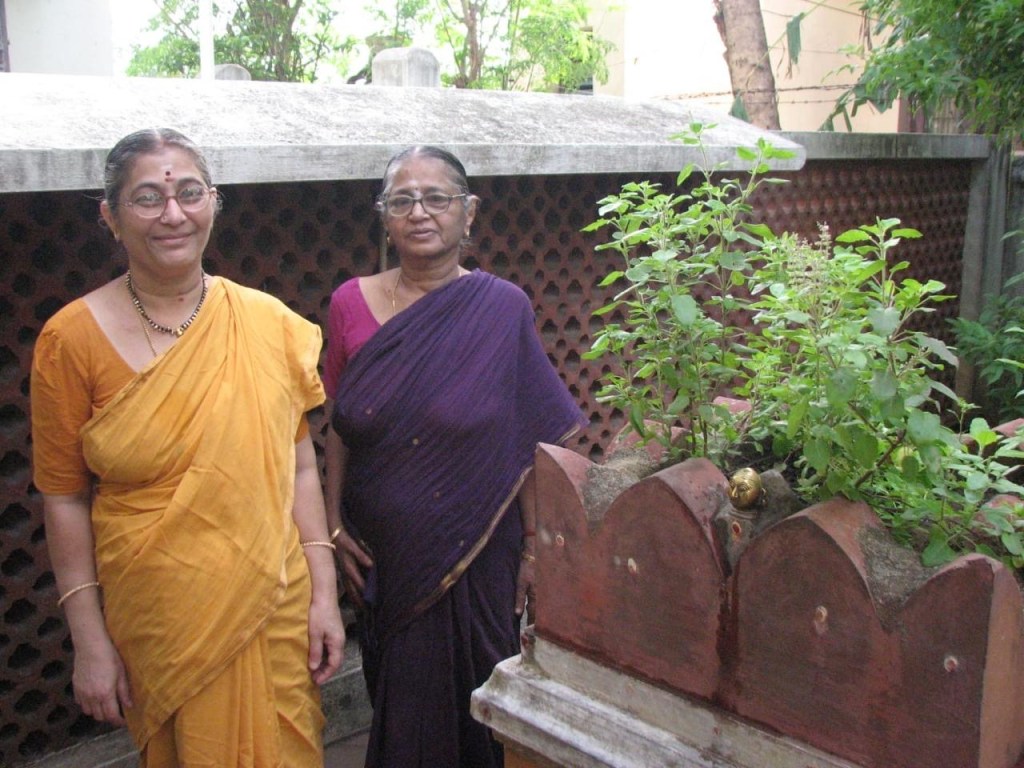
Some people carry grace like a quiet strength, touching the lives around them through simple, daily acts of love. In my husband’s mother – Amma – I discovered a woman whose beauty runs far deeper than what meets the eye, whose generous heart has shaped not just her family but everyone fortunate enough to witness her way of living.
When I first entered this family as a young bride, I was struck by more than just Amma’s natural beauty. There was something in the way she moved through her world – purposeful, caring, always thinking of others before herself. Over the years, what began as admiration has grown into deep respect and genuine affection.
In her, I found a mentor whose actions spoke louder than any words of advice.
The Art of Grace
There’s something almost magical about walking into Amma’s home. No matter when you arrive – whether it’s been planned for weeks or you’ve shown up unexpectedly – everything is immaculate. Not the cold perfection of a showroom, but the warm, lived-in cleanliness that speaks of care and respect.
In those early years of marriage, I was amazed by this aspect of her life. Despite her workload, despite being tired after long days, she ensured her work was done and, most importantly, that her space reflected the care she felt for her family. Her home wasn’t just clean – it was organized with a thoughtfulness that made everything feel intentional.
Over the years, I’ve come to understand her philosophy about our surroundings. The place around us is the one thing we can have control over, and when we keep it with neatness and care, that’s how we respect our space and ourselves.
I watched her live this philosophy every single day. She kept her things organized not out of obsession, but out of love. What I’ve always admired about Amma is her ability to not procrastinate or push things to a later date – she gets things done because she thinks it’s important. This applies not just to keeping her surroundings clean, but to everything in her life. She always dresses very neatly, presents herself with care, and tackles tasks without delay. This is another quality I can see clearly in my husband – he learned from her that important things shouldn’t be postponed.
Every time I visit India, even now when she and Appa are in their later years, I’m still amazed by how neat and tidy their house remains. Despite their age, their home still reflects that same grace and attention to detail.
What amazes me about Amma is her memory – it’s sharper than mine, and I’m much younger than her. She remembers details about conversations, events, and people that happened years ago. She even remembers exactly where things are placed in the house. She recalls exactly what was said, who was there, what was served. Her incredible memory helps her keep track of everyone she loves.
This became one of my greatest inspirations. Through witnessing her actions – never through words of instruction – I learned how keeping our space clean helps our minds feel clearer, more peaceful. I try to follow this lesson she taught me, though I often fall short of her standard of grace.
A Heart That Overflows
If there’s one thing that defines Amma’s approach to life, it’s abundance – not material abundance, but an abundance of heart. This shows most clearly in her kitchen, where no meal is ever planned for just the right number of people.
“It’s better to have more than for someone to have less,” I’ve come to understand this is her philosophy, and I’ve watched her live by this principle for over two decades. When guests come – whether it’s two people or ten – she always cooks extra. Always. I used to think this was just careful planning, but I came to understand it’s something deeper. It’s her way of showing love through provision, of ensuring that no one who enters her home ever feels there isn’t enough.
What moves me most is how she approaches her own needs. Every single day, Amma eats last. After making sure everyone in the family has had everything they need, after serving seconds and checking that everyone is satisfied, only then does she sit down to her own meal. I’ve tried countless times to negotiate with her about this, to convince her to eat with the rest of us, but I’ve lost every single one of these gentle battles.
This generosity extends beyond food. She gives of herself in countless small ways – remembering exactly how her family members like their coffee, ensuring their favorite dishes are prepared, thinking ahead to what might make their visits more comfortable. Her heart overflows with care for those closest to her.
Kitchen Companions
Some of my happiest memories with Amma happen in the kitchen. There’s something special about working alongside her – the easy rhythm we fall into, the way we can cook together without getting in each other’s way. She became not just my teacher but my companion in creating meals for the family.
In those early years of marriage, her kitchen became my classroom. Not through formal lessons, but through watching, trying, and gradually understanding the subtle art of South Indian cooking. Her cooking has so much taste, so much depth of flavor, and I learned by standing beside her, observing how she balanced spices, how she knew exactly when each dish was ready.
What meant so much to me was how she would encourage me when I cooked something she enjoyed. Coming from someone so experienced in the kitchen, her appreciation gave me confidence to keep trying new dishes and flavors.
But our connection goes beyond cooking techniques. We’re both women who love to enjoy life, who find pleasure in good food and good company. What I discovered about Amma is how beautifully spontaneous she is. Many times, in the middle of an ordinary day, I’d turn to her with a sudden idea.
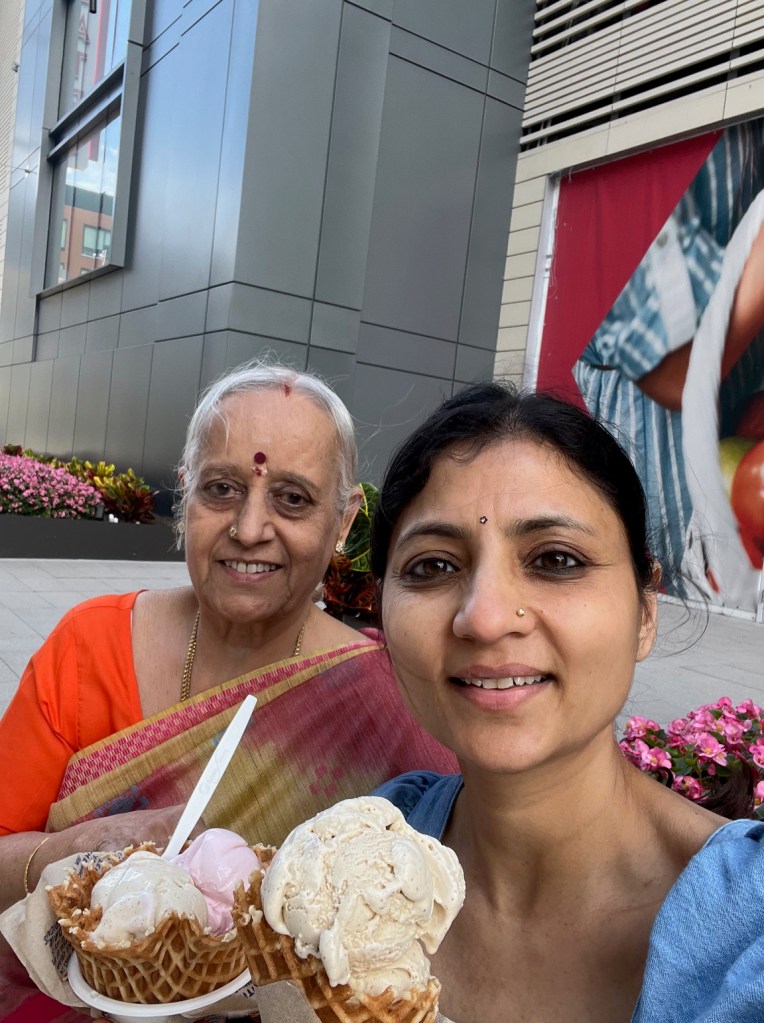
“Would you be interested in going out to eat?” I’d ask, and she would always say yes with such enthusiasm. Off we’d go – two women who shared a love for trying different foods, for the simple pleasure of eating something delicious without having to cook it ourselves.
Amma enjoys chaat – those wonderful North Indian snacks – and South Indian foods with equal enthusiasm. Be it food outings or watching movies together – another common interest we share – these became some of our best bonding moments.
What made our relationship so easy from the beginning was discovering that Amma, despite being from an older generation, wasn’t rigid or overly orthodox in her ways. She was ritualistic, yes, but in a practical way that worked for our family rather than being bound by tradition for tradition’s sake. This was such a blessing for me as a young bride – being someone who also isn’t too rigid or overly ritualistic, I found in her a kindred spirit who valued substance over strict adherence to form.
The Family Keeper
Amma carries the stories of her entire family in her heart. She’s deeply attached not just to her own children, but to the family she married into and her extended family – her brothers and their families. When she speaks of them, which she does often, it’s always with warmth and affection. I’ve never heard her say anything negative about any family member. Instead, she focuses on their positives, their kindness, the ways they’ve touched her life.
Through her stories, I’ve come to know these relatives as real people with beautiful qualities. She remembers all the small things someone has done for her – a thoughtful gesture from decades ago, a moment of kindness during a difficult time. Her gratitude runs deep, and she carries these memories like treasures.
Her love for her grandchildren is something truly special to witness. When my children were young and she and Appa would visit us here, the house would transform with her presence. She didn’t just babysit – she played with them, engaged with them, created a bond that my children still cherish.
I can still picture her playing card games with them, and she brought the same competitive spirit to these games that she had with the adults. She would playfully hide the jokers, keep a perfect poker face, and tease her young opponents with that mischievous glint in her eye. What I loved watching was how she never gave up her competitive edge just because they were children – she played with the same interest and determination, making the games genuinely challenging and exciting for them. She was an expert at card games, and even with her grandchildren, she played to win while making sure everyone had fun.
When they were toddlers, she would spend hours making their favorite pureed foods, taking such care to prepare exactly what they loved. She would sit with them during cartoon time, patiently feeding them spoonful by spoonful, completely absorbed in making sure they were well-nourished and happy and equally enjoying with them their favorite shows. Even now, years later, her first concern when the grandchildren visit is whether they’re hungry. She’ll immediately start thinking of what to cook for them, what would make them feel most loved and cared for.
Her cooking was aromatic, filling the house with wonderful scents. She made sure her grandchildren experienced the tastes and comfort of traditional South Indian foods she grew up with.
Lessons Without Words
The most powerful teachings often come not through lectures or advice, but through quiet examples. Amma taught me about life simply by living hers with such grace and intention.
From her, I learned that cleanliness and organization aren’t about perfection – they’re about creating a peaceful space where love can flourish. I learned that hospitality isn’t about having the fanciest things, but about making people feel genuinely welcomed and cared for.
I can see her influence clearly in my husband – the way he keeps things organized, his natural cleanliness, his attention to neatness. These aren’t traits he consciously learned; they’re simply part of who he is because of the mother who raised him.
Amma has other passions that bring her joy – she loves playing Sudoku and puzzle games, exercising her sharp mind with challenges that keep her engaged. I can see where my husband and children inherited their love for puzzles and mental games.
A Heart Full of Gratitude
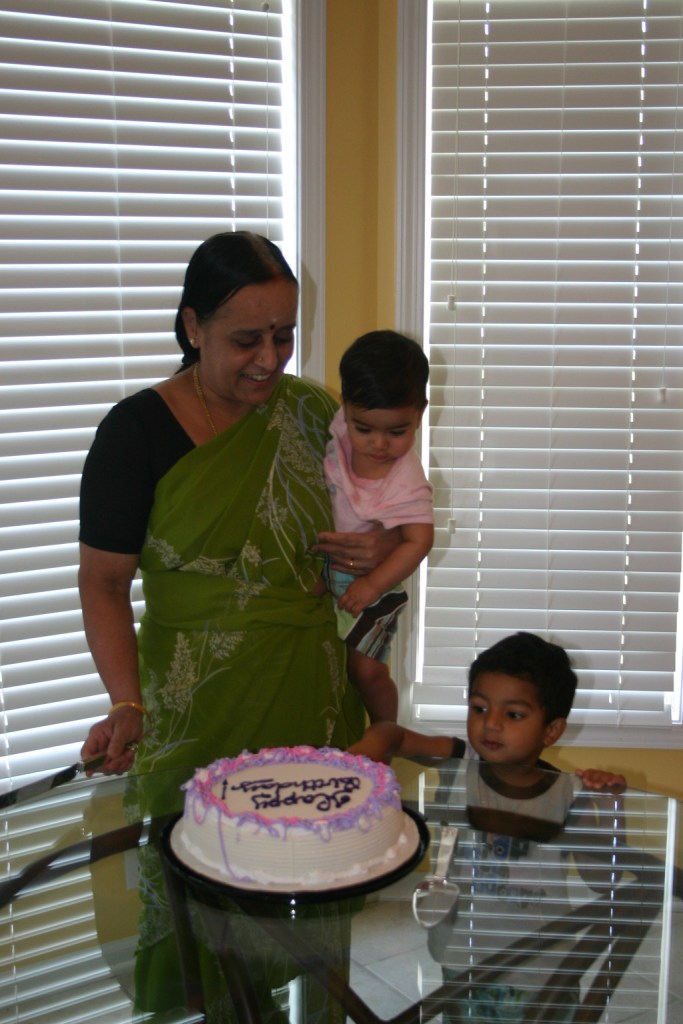
As I write this memoir as a birthday gift for Amma, I reflect on the woman she is and the many ways she has touched our family’s life.
What I’ve come to appreciate is how we’ve both grown in our understanding of each other over the years. Family relationships aren’t always simple, but there’s something valuable in learning to honor the good we see in each other.
Amma, as you celebrate another year of life, I want you to know how much your devotion to your children and grandchildren means to all of us. You’ve also been there during my difficult moments, listening with patience and understanding. That quiet support meant more to me than you might know.
I see how lovingly you care for Appa, always making sure he’s comfortable and has everything he needs. I find that very inspiring.
Your son carries your best qualities – your sense of organization, your attention to detail, your love of family. Your grandchildren light up when they remember those card games and the special foods you made just for them.
You’ve shown me what it means to maintain a graceful home, to care deeply for family, and to find joy in simple pleasures like a good meal shared or a challenging game of cards.
On this special day, I celebrate the gift of having witnessed your love for your family over all these years. May this new year bring you continued health, happiness, and many more moments of joy with those you hold most dear.
A Poem for you, Amma
Sweet moments with grandchildren, laughter we share, Your love for adventure takes you everywhere. Amma, you’ve touched our lives in countless ways, A life lived with purpose, a heart full of light.
As you celebrate another year of this beautiful life, We honor the woman, the mother, the wife. May this birthday bring joy, health, and cheer, To someone we cherish and hold very dear.
I must have been quite young, about 6-7 years, when I visited my father’s uncle in Adoni, a small city in Andhra Pradesh. That was the early 1980s, and their neighborhood had rows of small, tiled houses where everyone knew each other. It was a simpler time – not much of city development, just a close-knit community where neighbors seemed to care for each other. Their house was simple – a small house with a tiled roof with just three small rooms: a living room, a small kitchen, and a bedroom. What fascinated me most was the little room on the tiled roof that you could climb up to reach. It felt like a secret hideaway in that modest home.
They didn’t have a bathroom inside the house. Instead, we used the communal street bathroom. As a child accustomed to indoor bathrooms, this was genuinely difficult for me, but I managed. My parents had taught us to adjust gracefully when staying with others, to not make the hosts uncomfortable. They had shown my siblings and me that love and kindness mattered beyond anything.
Adoni Thatha (that’s how I called him) was a happy man who always lovingly addressed me as “Bangaru” (gold). He had this innocence about him and the way he laughed. He had a positivity that even as a young girl, I could feel – perhaps because I had experienced the absence of such warmth before. I felt happier around him and safe.
Looking back, I realize he was the first grandfather figure I felt connected to. Both my grandfathers had passed away before I was born. Even though we did not interact much, the time with him felt like being with my own grandfather.
What I remember most vividly is the Adoni upma that Avva (his wife, grandmother in my language) would make for me. I remember Thatha would rave about this food as it is a traditional food of the city and told me I would love it. He had asked his wife to make this for me. It is my favorite to this day. This south Indian upma was made with puffed rice that was soaked in water and drained. It was made mostly the usual way of making upma but at the end garnished with crushed roasted gram dal and roasted peanuts.
The Parrot with the Broken Wing
One of the most beautiful memories from that visit was a green parrot that Adoni Thatha cared for. This bird had fallen and broken its leg, and I watched how tenderly he took care of it. He kept the parrot in a cage to help it heal. He would take the bird out, wrap its leg with a bandage, and talk to it lovingly. He allowed me to play with the bird, and he would become like a child himself, playing and feeding it.
What touched me even more was learning later – months or maybe years after my visit – that once the parrot’s leg had completely healed, he set it free. This was one of the earliest memories I have of kindness to an animal that stayed with me. Even though he loved the bird dearly, he chose to let it fly away when it was ready. His love for the bird meant wanting it to be free.
Community Friendship
Adoni Avva was equally wonderful. I remember accompanying her as she worked with other women in the community, making cotton threads for lighting lamps in the temple. I don’t remember exactly what I did during those gatherings, but I remember I would observe how it is done and she let me weave a few cotton threads and taught me how to.
I would tag along when she went to visit her friends. As a child, I remember enjoying just observing the surroundings and soaking in the newness of the experiences.
What Children Remember
Looking back now, I realize something profound: children remember kindness above all else. Despite the uncomfortable bathroom situation, despite being in an unfamiliar place with relative strangers, what stayed with me was love.
I wasn’t there with my parents and siblings – it was just me in that small house with these caring people who made sure I felt welcomed, fed, and included. They could have seen my visit as an inconvenience, but instead they treated me, a little girl, like a treasured guest.
They took me around the community, introduced me to their world, and shared their simple but meaningful life with an open heart. In their small house, they made sure I had everything I needed to feel at home.
These memories have stayed with me, not because of any grand gesture or expensive gifts, but because of the genuine warmth I felt in that little house in Adoni. It taught me that hospitality isn’t about having the perfect home or the finest things – it’s about making someone feel truly seen, loved, and valued, and genuinely welcomed with your whole heart.
Pavitra had always believed that truth was enough. That if you were honest, if your intentions were pure, people would see that. Especially family. Especially the people who claimed to love you most.
But sometimes truth isn’t enough when people have already decided what they want to believe.
The Innocent Mistake
It started so innocently. Pavitra was managing the WhatsApp group for the community volunteer cleanup project when she saw a notification about her son Arjun’s friend, Vikram, who had helped with the last event. Without really thinking – just quickly trying to add helpful volunteers while managing multiple tasks – she accidentally added Vikram to the group chat.
Within minutes, Arjun was storming into the room, his face flushed with anger.
“Mom, what is wrong with you?” he said, his voice sharp and disrespectful. “Why are you adding my friends to random group chats? You’re making Vikram feel obligated to volunteer when he never asked for this. You’re crossing boundaries!”
Pavitra looked up from her phone in confusion. “Arjun, it was completely accidental. I was quickly adding people and …”
“That’s impossible,” he cut her off, his tone harsh in a way that made her heart sink. “You don’t accidentally add someone to a group. You had to search for his name, select it, and click add. You’re lying about this being an accident.”
“I can show you exactly how it happened,” Pavitra said, trying to keep her voice calm despite the familiar panic rising in her chest. “It was literally a matter of seconds; I was moving quickly through contacts and …”
“Stop lying to me!” His voice was cruel, cutting. “You did this deliberately and now you’re making up excuses. Just admit what you did!”
“Arjun, I’m sorry this happened,” Pavitra said, her voice breaking slightly. “It was completely an accident – it happened in a matter of seconds while I was managing the list. I’ll remove Vikram right now and let him know it was a mistake.”
But even her immediate apology and offer to fix the situation wasn’t enough. Arjun continued to glare at her with that look of disgust, as if she had committed some terrible crime instead of making an innocent mistake.
She found herself wondering – why was he making such a big deal out of this? Why was he speaking to her with such disrespect over something that could be so easily resolved? Was this just how this generation handled conflicts – with immediate accusations and refusal to accept explanations? Or was this something deeper, something about how he saw her, how he valued her feelings?
The questions swirled in her mind as she watched her son’s face, searching for any sign – some part of her son that could trust her, even a bit of willingness to give his mother the benefit of the doubt in that moment.
The Betrayal of Silence
What happened next shattered something inside Pavitra. Her husband, hearing the raised voices, came over and instead of asking for her side of the story or addressing Arjun’s disrespectful tone, immediately began trying to smooth things over.
“Arjun, calm down,” her husband said, but his next words cut deeper than his son’s accusations. “And Pavitra, maybe you should give the boys some space with their friendships. You know how sensitive these relationships can be at their age.”
The betrayal was complete. Not only was her husband not defending her against being called a liar by their own son, but he was also suggesting she was somehow in the wrong for accidentally adding a friend to a volunteer group.
This was no longer just about a group chat or volunteer list. When your own son calls you a liar and your husband sides with him instead of you, when they choose his comfort over your dignity, when they let him disrespect you in your own home – it becomes about everything that matters: respect, trust, and whether your feelings have any value in your own family.
Old Wounds, Fresh Pain
As Pavitra stood there, watching her husband smooth things over and her son avoid eye contact, she felt that familiar sensation – the walls closing in, the ground shifting beneath her feet. She had been here before. Different situation, same feeling of being utterly alone while surrounded by people who claimed to love her.
Years of similar moments came flooding back. Times when she had been misunderstood, when she had to defend her truth to deaf ears, when keeping the peace was more important than protecting her dignity. The accumulation of all those times when she had swallowed her hurt for the sake of family harmony.
Pavitra felt angry, upset and could not help crying and felt a panic. Her anxiety rose. Her voice rose and she began feeling out of control.
“I know what I did and why I did it,” she said angrily, her voice unsteady following the growing storm inside. “It was an accident that happened in seconds while I was managing the volunteer group. But if you’ve decided I’m a liar, nothing I say will change that.”
That day, Pavitra found herself eating emotionally, seeking comfort in food when comfort from family wasn’t there. She stayed away from them, spending time outside, trying to process the weight of feeling so alone in her own home.
The Loneliness of Being Right
Later that evening, after Arjun had stormed off to his room and the group chat issue had been “resolved” with apologies and Vikram being removed from the group, Pavitra sat alone in her kitchen. Her family had moved on as if nothing had happened. Her husband was watching TV and her son in his room.
But she couldn’t move on. Not from being called a liar when she had told the truth. Not from watching her family choose the path of least resistance instead of standing up for her. Not from the realization that in their eyes, her feelings mattered less than avoiding conflict.
She thought about all the times she had intervened when someone disrespected her family. How natural it felt to be a moral support for the people she loved, and how important it felt for her family to be heard, understood and be happy.
Why didn’t they feel that same instinct for her?
The Weight of Invisible Pain
The hardest part wasn’t even the accusation or the misunderstanding. It was Pavitra’s wondering – how could this happen? How could everyone just get over it and expect her to get over it too? How could they expect her to be okay and just be fine, to accept the disrespect without any apology, as if nothing had happened?
It was the way her pain became invisible the moment it became inconvenient.
Pavitra wondered if this was about a lack of empathy – the inability to put themselves in her shoes and truly understand what she was feeling. Could they see her pain and still choose the easier path? Was it about seeking quick comfort rather than going deeper into understanding what really happened? Was it about avoiding the emotional work of truly supporting each other through difficult moments?
Maybe it wasn’t that they didn’t care – maybe they just didn’t know how to handle the messiness of someone else’s pain when it felt easier to smooth things over and move on.
But she also realized something else: her truth didn’t need their validation to be real. Her worth didn’t depend on their recognition. And sometimes, the most powerful thing you can do is simply know your own heart, even when no one else seems to.
Moving Forward
That night, Pavitra wrote in her journal:
“Today I learned that some battles you fight alone, even when you’re surrounded by family. Today I learned that my truth belongs to me, whether others choose to see it or not. Today I learned that sometimes the people who should stand with you will choose comfort instead, and that doesn’t make you wrong – it just makes you strong.”
She didn’t know how to heal the hurt yet. She didn’t know how to bridge the gap between her need to be believed and their need to avoid conflict. But she knew she wouldn’t apologize for expecting basic respect from the people who claimed to love her.
She did realize deep within that the hurt she felt came from the expectations on how people need to be in her eyes. The moment she lets go of the expectations, she can be set free and there will be clarity, forgiveness and peace in her heart. She knows it is a matter of time when she will seek His help to let go of the expectation and be at peace. No one is responsible for her happiness except herself.
And maybe, just maybe, that understanding and insight is enough for now.
Every time she shares these childhood memories – even though I’ve heard them countless times – I find myself filled with the same joy and wonder that lights up her face. I have gathered here some of the stories she has shared with me over the years. I never grow tired of listening to these tales. Instead, I am marveled at the innocence and plain adoration she has for her siblings. Watching her describe these incidents with such delight, even now at seventy-two, fills me with gratitude for her, for her upbringing, and for the joy she carries through life.
In a recent video call, my mother narrated her times with her siblings. Even though I listened to many of these stories before, I was delighted and engaged in her stories, smiling at her enthusiastic narrations of her childhood times with her cute expressions.
My mother with her younger brother Subi Mama
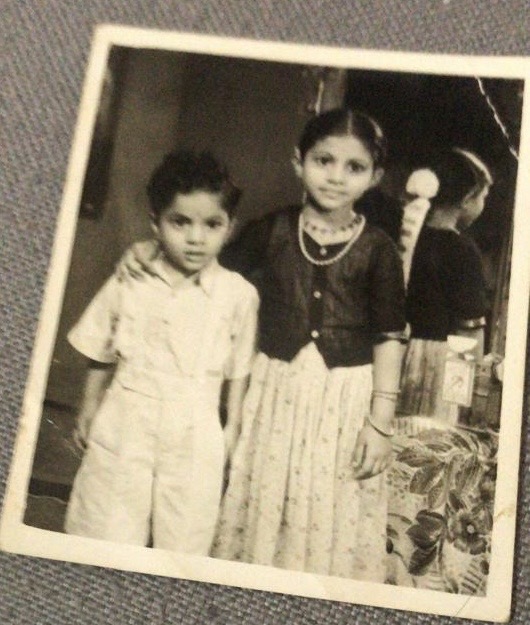
My mom Lakshmi’s face lights up when she talks about her family. At seventy-two, she still giggles like a child when she mentions Subi Mama, her younger brother and partner in mischief. When she speaks of Vicha Mama (Vishwanathan), her elder brother who was thirteen years older, she transforms into a respectful student, still in awe of his wisdom. And then there’s Balamma, whom we lovingly call Pedhamma (which means “elder mother” in Telugu), who was 15 years older than my mother and whose quiet strength has inspired us all.
When Mom talks about her brothers, her whole face changes. Stories about Subi Mama bring out her playful side – she smiles and laughs with that same childhood mischief in her eyes. But when she speaks of Vicha Mama, she becomes almost reverent – still grateful for her brother’s loving guidance.
My mother’s elder brother Vicha Mama
The Salt Surprise
When my mother was a little girl, she had a sweet tooth that often got her into trouble. Whenever she thought no one was looking, her small hands would sneak into the sugar box. She’d keep watch at the door while quickly scooping sugar into her mouth, enjoying her secret treat.
What she didn’t know was that Vicha Mama, her elder brother who was studying to be a doctor, had noticed her sugar stealing. One day, he quietly switched the sugar and salt containers.
That afternoon, when my mother dipped her fingers into what she thought was sugar, her face twisted in shock as salt filled her mouth.
“You think you had sugar,” Vicha Mama said, suddenly appearing in the doorway with a stern face hiding a hint of a smile. “But now it’s salt. I know what you’ve been doing, all that stealing.”
He made her finish what was in her mouth. “You need to swallow it all,” he said firmly.
Tears filled my mother’s eyes as she swallowed, but the lesson stuck with her forever. It wasn’t meant to be cruel – it was Vicha Mama’s way of teaching her to be honest, even when nobody seemed to be watching.
She is 72 years old now and still sneaks sugar and candies when we’re not looking. I’ll catch her with a sweet in her mouth, and she’ll give me that same guilty smile from her childhood stories.
Sweet Mango Days
Summer meant mangoes – sweet and juicy. Vicha Mama would hand-pick the ripest ones and bring them home for his younger siblings. My mother and Subi Mama would sit together eating mangoes, juice dripping down their chins, giggling as they enjoyed their treat.
“This is the best thing in the world even with the fiber that gets stuck in your teeth, it made it even more fun,” my mother would say, with those naughty eyes. I never understood how she could be so excited about something that left strings between your teeth, but her enthusiasm was infectious.
But one day, my mother got suspicious. She thought her elder brother was keeping the biggest, juiciest mangoes for himself. When no one was looking, she stole a large, perfect-looking mango from his room.
Her excitement quickly turned to disappointment when her first bite revealed it was sour and unripe. Before she could hide the evidence, Vicha Mama found her.
“Why don’t you wait for me to give you the best mango?” he asked, looking disappointed but not angry. “The best mangoes have wrinkles on the skin – that means they’re sweet. The big, smooth ones are usually sour.”
He made her eat the entire mango, teaching her another lesson: patience is virtue.
Learning Order from Chaos
Vicha Mama believed in teaching his siblings how to take care of themselves. On Saturday afternoons, he would empty their cupboards, throwing all the clothes on the floor in what looked like a mess. But he had a plan.
“Watch carefully,” he would say, showing them exactly how to fold each piece of clothing. “By the time I come back, everything needs to be back in the cupboard, neatly organized.”
Even the freshly ironed clothes weren’t spared from this weekly lesson. My mother and Subi Mama would work together, their small hands learning to transform disorder into harmony. These Saturday organizing sessions became a kind of ritual – first the chaos, then the teamwork, and finally the satisfaction of a job well done.
Penmanship and Character
“Your handwriting must be neat and very clear. It must reflect your mind,” Vicha Mama once told my mother, and she took this to heart.
He taught his little sister to leave exactly one little finger’s width between each word. He would watch as she practiced, gently guiding her hand across the page. “Make each letter clear,” he would say.
Today, at seventy-two, my mother’s handwriting is still beautiful – whether she’s writing in English, Telugu, or Tamil. Each letter is carefully formed, each word has its proper space. Her writing isn’t just words on paper – it’s a kind of art that shows how clearly she thinks.
Watching her write even a simple note is like watching someone who has practiced the same careful movements for decades. Her pen moves smoothly, never rushing. I marvel at her patience in enjoying the writing process – something never meant to be done quickly – in our world of quick typing and text messages.
Learning Self-Reliance
When school started each year, my mother and Subi Mama would first ask their house helper to cover their books with brown paper and put on neat labels. When her elder brother found out about this, he decided it was time for another lesson.
“You’re old enough to do this yourselves,” he told them, my mother studying in ninth grade at that time.
Step by step, he showed them how to measure the paper, make clean folds, and secure the corners. “From now on, you’ll do this yourselves,” he said.
This skill stayed with my mother her whole life. Years later, I would watch in amazement as she covered our schoolbooks with the same careful attention, neatly binding them. Those bindings weren’t just neat – they stayed strong and firm throughout the school year, protecting our books through daily wear and countless openings.
Paper Bits in the Breeze
While Vicha Mama was the teacher, my mother found a best friend in her younger brother, Subi Mama. When their parents would go out to see a movie, the siblings would say:
“Oh, you go. We’ll be fine at home” with angelic faces masking the playful schemes already forming in their minds.
Once alone, they would tear paper into tiny pieces, gather them in their hands, and run outside to throw them into the air, watching the bits float like snow. They never got caught for these small adventures, their shared secret bringing them closer together.
In the 50s and 60s, when social media was not part of the world and with many homes not having a television, children found creative ways to spend their time and play. I would say back then there was more quality time spent with each other, and people had a lot more time appreciating the little things in life.
As they grew up, their connection stayed just as strong. Being separated by less than two years in age helped them see each other not just as siblings but as true confidants. They became each other’s trusted friends, protectors, and supporters through life’s journey – their deep bond nurtured by those childhood conspiracies.
Strength Through Silence
My mother with her eldest sister (my mother on left, Pedhamma on the right)
Apart from these childhood adventures was Balamma, my mother’s eldest sister. Married young, as was common then, Pedhamma only appears in my mother’s early memories as a visitor who came home with her young son during vacations. But her influence on our family was deep and lasting.
Pedhamma’s life was filled with heartbreak – a genetic disease in her husband’s family took not only her husband but two of her children as well. As a single mother, she faced these terrible losses and many other hardships with a quiet dignity that touched everyone who knew her.
What made Pedhamma so special wasn’t just that she survived these troubles, but that she never felt sorry for herself or became bitter. She never complained, never acted like a victim, never let her own pain stop her from loving others. She would cry for someone else’s problems before even mentioning her own, facing each new challenge with quiet strength and dignity instead of giving up.
When my mother or her siblings had problems in their own lives, they would think of their eldest sister. Their troubles would suddenly seem smaller compared to what she had been through and how gracefully she handled it all.
Today, Pedhamma’s memory lives on in our family. Her name stands for accepting life’s hardships with dignity – not by giving up, but by acknowledging reality in a way that lets you move forward without being defined by your troubles. She showed them that real strength isn’t about avoiding hard times, but about how you carry yourself through them. Her perseverance, patience and love showed all of us how to accept life’s challenges and act from the place of now.
Stories that Bind Us
My childhood summers were filled with fun and excitement of meeting my cousins and staying at my Mamas’ and Pedhamma’s.
At Vicha Mama’s, I’d bubble with excitement as he’d greet me at Warangal station with that precious flask of vanilla ice cream – a small gesture that made me feel so special.
My time at Pedhamma’s house created another kind of joy – simple, happy times spent playing with neighborhood children, exploring freely in a loving space under the watchful eyes of my mother’s eldest sister. Pedhamma spoke little but loved deeply – strict yet never judgmental. Her quiet way of showing affection created a peaceful haven I looked forward to every school break.
Then there were the magical stays at Subi Mama’s home in Bhimli. His house, surrounded by mango trees in the ashram grounds, became my childhood paradise. The sound of ocean waves in the nights felt soothing and shifted us to a place of calmness. There was nothing like the thrill of climbing those mango trees with my cousins or playing hide-and-seek within that big compound.
Even now, when my mother and Subi Mama get together, the years fall away and they become those children again – the ones who once threw paper bits into the summer breeze. When she tells stories about their mischief, her eyes light up with that same playful sparkle, her laughter as fresh as it must have been back then. And when she talks about Vicha Mama, her voice fills with the same respect and love she’s felt her whole life for the brother who taught her so many important lessons – sometimes strict, always loving, forever shaping the person she became.
In my mother’s life at seventy-two, her relationships with her siblings remain the strongest foundation in her life. Their love for each other, the playfulness, and wisdom continue to influence not just her, but all of us who came after. The reverence we children feel for our Mamas and Pedhamma mirrors what my mother feels for her own siblings – a cycle of love and respect that continues through generations.
The stories she shares now – about sugar turned to salt, about sour and sweet mangoes, about paper pieces floating in the wind – are more than just childhood memories. They form the foundation of who she is. There is a special joy in watching my mother become a child again, her face lighting up as she relives these precious moments from her past.
The invitation came when I was already exhausted, the kind of bone-deep fatigue that makes even blinking feel like work. A group text: Dinner at Golden Dragon, 7PM. Don’t be late.
I thumbed back a quick response: “Can’t tonight. Deadlines”
The reply was immediate: “You’ve canceled three times. We’re staging an intervention. We’ll pick you up.”
Something about the message made my chest tighten. Not anxiety exactly – something older, more primal. A warning. But I dismissed it as social fatigue and sent back a thumbs-up emoji that felt like surrender.
The day had been endless. Client meetings where I nodded and smiled while my mind screamed for silence. A task list that kept multiplying like bacteria. By six, my eyes burned from staring at screens, and my shoulders had formed a permanent arch of tension.
“Just get through dinner,” I muttered to myself in the bathroom mirror. “Two hours max, then bed.”
The face that stared back looked like a poorly made copy of me – skin too pale, tired eyes, hair limp despite my attempts to revive it. I looked at myself for a few moments forcing a smile and touching my makeup.
Chapter 2: The Quiet Unravelling
Wind cut through my coat as I waited on the curb. When Liah’s car finally pulled up, I quickly hurried shivering, cold winds seeming to cut through my face.
“You look terrible,” she said as I slid into the backseat. Derek turned from the passenger seat, his smile faltering when he saw my face.
“Thanks,” I said. “Been working on this look all day.”
“We could take you home,” Liah offered, but there was reluctance in her voice.
“I’m fine,” I lied. “Just tired.”
We crossed into the older part of town, where streets grew narrower, the sidewalks emptier. I pressed my forehead against the cool window glass and watched my breath create circles of fog.
Something moved in my peripheral vision – a figure standing motionless on a corner, facing our car as we passed. A woman in a red dress, her face a pale oval in the darkness. I turned to get a better look, but she was already behind us, swallowed by the dark shadows.
“We’re here,” Derek announced, gesturing toward a storefront with faded gold characters painted on a red sign. “Golden Dragon”. The paint was peeling at the edges, the dragon’s tail curling back on itself in an impossible loop.
“I thought this place closed years ago,” I said.
“Reopened last month,” Liah said, already stepping out. “Supposedly the food is amazing.”
The sidewalk felt unsteady beneath my feet, as if the concrete had turned to something less solid. A wave of nausea swept through me, brief but intense enough that I had to close my eyes.
“You okay?” Derek’s hand on my elbow, steadying me.
“Yeah, just…” I opened my eyes and saw her again. The woman in the red dress, now across the street, standing perfectly still beneath a flickering streetlight. Looking directly at me.
“Just dizzy for a second,” I finished, but when I looked back, the woman was gone.
Chapter 3: The Uncanny Gathering
The restaurant’s interior was dimmer than I expected, the overhead lights turned low, most of the illumination coming from red paper lanterns that cast more shadow than light. The air was thick with competing scents – ginger and garlic and something sweeter, almost cloying. Conversations hummed at a dozen tables, but there was something off about the rhythm, as if everyone were speaking on a slight delay at a deliberate pace.
“We’re meeting Trevor and Sarah,” Liah said, scanning the room. “There they are!”
As we wound through the tables, I felt the weight of multiple gazes. A middle-aged man paused with chopsticks halfway to his mouth, eyes following our progress. An elderly couple turned in unison to watch us pass, their smiles identical and fixed. A young woman in the corner stared openly, her head tilted at a curious angle.
I folded my arms tight across my chest, suddenly aware of my heartbeat – too fast, too loud.
“It’s nothing”, I told myself. “Just my social anxiety acting up.”
Our table was near the back, partially concealed by a wooden screen carved with intricate scenes – mountains, rivers, tiny figures engaged in activities I couldn’t quite make out.
Trevor and Sarah were already seated, cocktails half-finished in front of them. Hugs, hellos, the familiar dance of greetings. I went through the motions while scanning the room, trying to understand what felt so wrong.
“Hello Madeline!” Sarah waved a hand in front of my face. “You with us?”
“Sorry,” I forced a smile. “Long day.”
“Well, you’re here now,” Trevor said, pushing a menu toward me. “Food will help.”
The characters on the menu seemed to shift slightly as I tried to read them, as if reluctant to be pinned down to definite meaning. I blinked, and they settled.
“I’m not very hungry,” I said. “Maybe just some jasmine tea.”
Liah rolled her eyes. “You need to eat something. How about a good salad?” She placed her hands lovingly on mine with a smile. I smiled back and said “Yes”
The waitress materialized beside our table so suddenly that I was startled. She was older than I’d first thought – sixty at least, perhaps older – wearing a high-collared black dress that belonged to another era. Her hair was pulled back severely from her face, emphasizing sharp cheekbones and eyes so dark they appeared pupil-less in the dim light.
“What can I get you?” she asked, her voice surprisingly melodic.
The others ordered enthusiastically – dumplings, Szechuan rice, noodles, something with black bean sauce. I stared at the waitress’s hands as she wrote, noticing how the tendons stood out beneath paper-thin skin, how her nails curved slightly too long, slightly too sharp. Her plastic smile revealed teeth that seemed too uniform, too white.
“And for you?” she asked, turning to me. Our eyes met, and a jolt of recognition shot through me, though I was certain we’d never met.
“I will have the garden salad and dressing on the side, please. And jasmine tea.” I replied.
As she walked away, I fought the urge to watch her go, certain that her movements would be too smooth, too gliding.
“Does anything seem off to you? About this place?”, I asked my friends.
Derek glanced around. “It’s a bit… offbeat, I guess.”
“Supposedly they serve good authentic food,” Trevor added, as if that explained the prickling sensation at the back of my neck.
The conversation moved on – work complaints, diet experiments, dating disasters, movies no one had time to watch. I nodded at appropriate intervals, laughed when required, but remained mostly silent, sipping the scalding tea the waitress had delivered.
Across the restaurant, I spotted her again – not the waitress, but the woman from outside. She sat alone at a small table, a cup of tea before her, untouched. She wore a red dress with mandarin collar, hair pulled back in a style similar to the waitress’s. She stared directly at me, her lips curved in a smile that didn’t reach her eyes. The smile felt lifeless, scary and deliberate without any heartfelt meaning.
I looked away, heart pounding. When I dared to look back seconds later, her table was empty.
The food arrived, steam rising in fragrant clouds. My friends dove in, passing plates, exclaiming over flavors. I watched their chopsticks move from plate to mouth, plate to mouth, the repetition almost hypnotic. The nausea returned, stronger this time, accompanied by a light-headedness that made the room seem to move in angles.
“Try this,” Derek insisted, placing something on my plate. I stared at it, unable to identify what it was supposed to be. The texture looked wrong – too glossy, almost pulsing.
I pushed the plate away. “Maybe just a little rice.”
The waitress appeared again, refilling my water without asking. “I hope you are enjoying everything”, she inquired, her eyes fixed on mine with an intensity that felt invasive.
“Just tired,” I said, the explanation wearing thin even to my own ears.
“You should eat some more,” she said, her smile widening a fraction too far. The words felt empty.
As she spoke, I noticed the restaurant had grown quieter. Conversations at nearby tables had paused, heads turned slightly in our direction. The man who’d watched us enter now sat motionless, chopsticks still suspended, food forgotten. The elderly couple smiled identical smiles. The young woman in the corner tilted her head further, as if listening for something just beyond hearing.
All of them watching. All of them smiling.
I stood abruptly, my chair scraping loudly against the floor. “Bathroom,” I mumbled, already moving.
The restroom was at the back of the restaurant, down a narrow hallway lined with faded photographs – black and white family pictures. The fluorescent light flickered overhead, casting alternating moments of harsh clarity and pool-like shadow.
I pushed through the door. Inside, a single bulb illuminated a small space with two stalls and a sink beneath a mirror.
I ran cold water, splashed my face, trying to shock myself back to normalcy. When I looked up, water dripping from my chin, I saw her in the mirror – the woman from outside, from the empty table. Standing directly behind me.
I whirled around, heart slamming.
No one.
The stall doors stood open, revealing empty spaces. I was alone.
Turning back to the mirror, I gripped the edge of the sink, studying my reflection. For a moment – just a moment – my reflection seemed to move independently, the head tilting in curiosity while I stood frozen.
“Get it together,” I whispered, and the reflection’s lips moved in sync again.
When I returned to the table, the others were finishing their meal, plates nearly empty. Liah looked up with concern.
“You were gone a while.”
“Sorry,” I said, sliding back into my seat.
The waitress appeared beside me, making me jump again. She carried a small tray with five fortune cookies arranged in a perfect circle.
“No meal is complete without fortune,” she said, placing the tray in the center of the table.
The others reached eagerly, but I kept my hands in my lap. The waitress remained beside me, waiting, that strange smile still fixed on her face.
“Take one,” she insisted, her voice dropping to a near-whisper. “It’s tradition.”
“Madeline, come on,” Sarah urged. “Don’t be a spoilsport.”
With reluctance, I reached for the last cookie on the tray. The moment my fingers touched it, the waitress’s smile widened.
“Good choice,” she said. “That one is specially for you, my dear.”
She walked away, and I stared at the cookie in my palm. It looked ordinary enough – golden-brown, slightly curved, with the characteristic cracked surface. Yet it felt heavier than it should, as if something more substantial than paper waited inside.
Around me, my friends cracked their cookies open, reading their fortunes with exaggerated voices.
“‘A journey of a thousand miles begins with a single step,'” Derek read, rolling his eyes. “Profound.”
“‘Your smile is a treasure to all who know you,'” Liah laughed. “At least mine’s personalized.”
“Your turn,” Trevor nodded toward my unopened cookie.
With a sense of inevitability, I broke the cookie in half. The paper inside was folded more elaborately than usual, origami-like in its precision. I unfolded it carefully, revealing elegant calligraphy rather than the expected machine print.
“You will soon see yourself clearly.”
Something cold settled in my stomach. I looked up, scanning the restaurant for the waitress, for the woman in red. Both were nowhere to be seen.
“What’s it say?” Sarah asked.
“Nothing interesting,” I folded the paper quickly, slipping it into my pocket. “Just the usual cryptic nonsense.”
Chapter 4: Shadow Pursuit
Outside, the night had grown colder, the wind sharper. The streets were deserted now, storefronts dark, the sidewalks gleaming with recent rain.
“Sure you don’t want a ride?” Liah asked as the others climbed into her car.
“I need the air,” I said. “It’s not far.”
“Text when you get home,” she insisted.
I nodded, already turning away, drawing my coat tighter. The cold felt cleansing after the closeness of the restaurant, the sharp air replacing the sweet-sour scents that had clung to my clothes, my hair.
As Liah’s taillights disappeared around a corner, I began walking, focusing on the rhythm of my steps, the sound of my breath. The nausea had subsided, replaced by exhaustion so complete it made my vision blur at the edges.
Home. Shower. Bed. The mantra carried me forward.
I was two blocks from my apartment when I realized I was being followed.
The footsteps behind me matched my pace exactly, creating an echo effect that had masked their presence until I paused at a crosswalk. Then I heard it – a second set of steps, halting when I halted.
I turned slowly, expecting to see the woman in red, the waitress with her too-wide smile.
No one.
The street stretched empty behind me, pools of lamplight illuminating vacant sidewalk. I peered into shadows between buildings, searched for movement, for watching eyes.
Nothing.
Imagination. Fatigue. Too many late nights, too much caffeine, too little real food.
I hurried the rest of the way home, fumbling with my keys at the entrance to my building, glancing repeatedly over my shoulder. Inside, the familiar lobby with bright lights and aging furniture felt like sanctuary. I leaned against the wall of the elevator, eyes closed, focusing on my breath as it carried me to the sixth floor.
Chapter 5: The Descent
My apartment welcomed me with silence and the faint scent of the morning’s coffee. I locked the door, checked it twice, then moved methodically through my evening routine – coat hung in the closet, shoes neatly arranged in the cabinet, bag in my closet. I filled fresh water in my electric kettle and turned it on and slipped into the shower.
The hot shower was salvation, steam enveloping me, water pressure working at the knots in my shoulders, my neck. I stood under the spray until my skin flushed pink, until the bathroom mirror fogged completely, obscuring my reflection.
Clean, warm, wrapped in my softest towel, I went through my skin routine. I slathered lavender oil on my skin. Wore my comfort pajamas, lighted a candle and sat on the couch. I leaned back, sitting silently.
My body felt heavy, as if gravity had increased its pull on me alone. Even my eyelids seemed weighted, requiring effort to keep open. Yet beneath the fatigue, something hummed – a strange energy, vibrating just below the threshold of perception.
“You will soon see yourself clearly”
The fortune replayed in my mind, the elegant script appearing against the darkness of my closed eyelids. What had seemed ominous now felt almost comforting, a promise rather than a threat.
I felt myself drifting, consciousness spiraling inward like water down a drain. Circles within circles, pulling me deeper. A curious sensation of both falling and watching myself fall, as if I were simultaneously the experience and the observer of the experience.
The vibration intensified, rising from subliminal to palpable. My body felt both impossibly heavy and curiously insubstantial, as if I might sink through the couch, through the floor, or simply dissipate into the air.
Something was happening. Something was changing.
With enormous effort, I opened my eyes.
And saw myself, still seated on the couch, eyes closed, mouth slightly open, chest rising and falling in the slow rhythm of deep sleep.
I stood – or rather, I experienced standing – moving away from the couch, from the body still occupying it.
There, on my couch, was someone in deep sleep, mouth slightly open, doing that weird snore-breathe thing that we all insist we never do.
Was it me?
I see myself from an out-of-body experience. Did I die? Is this an afterworld? As true as that sounds and feels, it does not. I am seeing myself sleeping.
And I am not alone in watching.
Chapter 6: The Fragmenting
I hover near the ceiling, weightless yet anchored by the sight below me. Somehow, I’ve become something else—a consciousness separate from my body. There I am – Madeline – asleep on the couch, vulnerable and unaware.
“No, not just asleep. Exposed.”
A strange detachment washes over me as I observe this body that has carried me through life. I’ve never truly seen myself this way – not in mirrors, not in photographs. Those were always filtered through my own perception, through the voice that has whispered critiques since childhood.
Now I see everything with unforgiving clarity.
Her thinning hair when her head tilts forward. The rounded shoulders curved from years hunched over keyboards and phones. The stomach that rises and falls with each breath, soft and unconstrained by daytime garments designed to flatten, to minimize, to hide the bubble of fat all around her body, her aging skin.
“Look at you,” I hear myself think, with disgust and embarrassment.
The thought comes with practiced ease, an old script I’ve performed thousands of times. But something is different now. I’m both the critic and, strangely, a witness to the criticism.
Below me, Madeline stirs. Her brow furrows slightly, breath catching. Her eyes dart rapidly beneath closed lids.
“Someone’s here,” she murmurs, eyes still closed. Her hand gropes blindly for her phone. “Someone’s watching.”
I drift closer, fascinated. Has she always sensed me? This other presence sharing her consciousness?
Her phone screen illuminates, casting a bright blue light across her face. The time reads 12:30 AM.
Madeline’s eyes open suddenly. She bolts upright, scanning the room with panicked intensity as if sensing a presence watching her.
For a moment, I think she’s addressing me. But her gaze is fixed on the darkest corner of the room.
I turn my attention there and see… something. A darkness with dimension. A presence more substantial than shadow yet less definite than form.
“We are not alone.”
“Who’s there?” Madeline demands, clutching her phone.
The shadow does not respond, does not move, yet somehow gives the impression of patient observation.
Has it always been there? Watching us both? The watcher of the watcher?
“I’m losing my mind,” Madeline whispers, and I’m unsure if she’s speaking to the empty room or to herself or to me. “This isn’t real. This can’t be real.”
She stands, moving to the bathroom. I follow, drawn by an invisible tether. The darkness in the corner remains where it is, unmoving.
Madeline flicks on the harsh bathroom light, confronts her reflection in the mirror. I hover just behind her, expecting to see my translucent form reflected beside hers. But the mirror shows only Madeline, dark circles under her eyes.
Then – just for an instant – two reflections appear in the mirror. Madeline in the center. To her left, a woman in the red dress looking at Madeline smiling at her.
Madeline screams, stumbling backward. When we look again, the mirror shows only Madeline’s terrified face.
“What’s happening to me?” she gasps. She pops in two sleeping pills.
“It’s not real,” she repeats like a mantra. “It’s stress. It’s exhaustion. It’s the medication.”
But her eyes keep darting to the corners of the bathroom, searching for watchers.
I drift closer, wanting to communicate, to understand what’s happening. As I move toward Madeline, my attention is suddenly diverted…
I notice the woman in the red dress looking at me, smiling at me. Madeline cannot see her this time.
The fortune cookie message flashes in my mind: “You will soon see yourself clearly.”
But what self am I seeing? Which of us is real? The sleeping woman? The critical observer? Or something else entirely, watching from the shadows?
Madeline’s breathing slows as the second pill takes effect. Her eyes grow heavy. “Tomorrow,” she murmurs. “I’ll call Dr. Levine tomorrow. Something’s… wrong with me.” She walks towards her bedroom trying to sleep.
As she drifts back to sleep, slumped awkwardly on her bed with her knees drawn to her chest, I feel something on my back. Not pulling me toward Madeline, but away – as if something is trying to sever the connection between me and her.
The bathroom door swings open by itself. The light flickers. Something pulls me by force towards the bathroom. I am now in the bathroom.
In the mirror, the woman in the red dress appears again, alone this time.
She raises one finger to her lips in a shushing gesture, then points to wall behind me with a strange smile.
“We are not the first,” she mouths silently. “And we will not be the last.”
The mirror cracks suddenly, a spiderweb of fractures spreading from the center. In each fragment, a different face appears – all women, all with the same hollow eyes and desperate expressions.
I try to scream but have no voice. I try to wake Madeline and warn her but cannot touch her.
I’m suddenly pulled back to the bedroom, hovering weightlessly on the ceiling, looking down at Madeline. And there, in the corner of the ceiling, I see another observer. And another. And another.
All watching. All waiting for Madeline to wake up. The woman in the red dress standing beside the bed looking at Madeline, smiling strangely at her.
I look at the others like me who are watching Madeline, each one waiting for their chance to speak to Madeline once she is awake. They do not seem to care much about the woman in the red dress, or can they even see her?
But then I notice something even more disturbing. From each observer, smaller fragments are beginning to split off – miniature critics watching the critics, judging the judges. One whispers, “You’re not harsh enough with her.” Another protests, “Please be gentle on her. Share some love.” Another murmurs, “You let her sleep too peacefully but why?” Each fragment spawns another, and another, a fractal pattern of judgment multiplying endlessly.
The woman in red walks among these multiplying parts, touching some, whispering to others, her smile growing wider with each new fragment that forms.
The fortune cookie was right. I am seeing myself clearly for the first time. But, who is “I”?
I try to return to Madeline, to merge with her, to wake her but I cannot. Am I the only one that feels sorry for Madeline?
One of the shadow figures steps forward. When it speaks, its voice is familiar – the same voice that has criticized Madeline’s every move, every choice, every flaw. My voice.
“It is time,” the woman in the red dress talks to all the shadows. “She is ready.”
Ready for what, I don’t know. But as the shadows advance, I understand one terrible truth:
This has all happened before.
And it will all happen again.
The woman in the red dress now directly looks at me. I cannot breathe. It feels like I am being eliminated from her glance. I seem to suffocate. I have not felt anything like this before. I do not have a physical body but what is this feeling I feel?
Chapter 7: What Follows
Madeline jolts awake with a gasp, heart pounding. Sunlight streams through the living room blinds, casting striped shadows across her body. She’s on the couch, still wearing yesterday’s clothes.
10:07 AM.
“God,” she mutters, rubbing her face. Her mouth is dry, head foggy. “What a nightmare.”
She tries to piece together what was real. The invitation to Golden Dragon had been real – the text messages from her friends asking her to join them. But she hadn’t gone. No, she remembers now: declining the invitation, walking home through the cold, collapsing on the couch fully dressed.
Everything else – the restaurant, the woman in red dress, the fortune cookie, the observers – all of it had been a dream. A vivid, terrifying dream that still clung to her like cobwebs.
“Stress dream,” she tells herself firmly. “Anxiety manifestation. Classic symbolism.”
The bathroom door is ajar, light off. She approaches it cautiously, pushes it open with one finger.
The mirror is intact, showing only her pale, frightened face.
But as she turns to leave, something catches her eye. A business card on the counter that wasn’t there before.
She picks it up, turns it over in her hand.
“Dr. Amelia Levine, Psychotherapist” “Specializing in dissociative disorders and trauma”
Madeline has never heard of Dr. Levine. Has never seen this card before. Has no idea where it came from.
Her phone chimes with a text notification. Unknown number.
“Did you sleep well, Madeline? You’re not alone anymore.”
She stares at the message, a chill running through her. Probably just spam, she tells herself, but how would a random spammer know her name? And the timing, so soon after her nightmare…
She moves to the window and pulls the blinds fully open, needing daylight, normality. On the street below, pedestrians move about their morning routines. A man walks his dog. A woman checks her watch.
And there, directly across the street, standing perfectly still beneath a tree…
A woman in a red dress with a mandarin collar, face a pale oval, looking directly up at Madeline’s window.
As their eyes meet, the woman’s lips curve into that same lifeless smile from the dream.
Madeline backs away from the window, heart hammering against her ribs. Something in the apartment feels different now. The air seems heavier, charged with an unfamiliar energy. The space behind her feels occupied, as if the empty rooms are no longer empty.
She turns slowly, scanning the room. Nothing visible, but she cannot deny the feeling that something feels off. Maybe she is still recovering from her nightmare?
“Hello,” she whispers.
Only silence answers, but it’s a silence that listens.
Happily walking towards my mom’s car, Orange leash tethered to my harness. Walking sideways with a wiggle and joy, I hear my mom opening the car with her keys.
“Ready, Tuffy? Jump!”
I finally figured the way in, that is right. Sitting in the rear seat of my mom’s car, A little whine and she understands. Mom lowers the windows just for me.
Cool fresh breeze tickling my whiskers, Smelling Spring’s sweet air. Shedding season it is, but I don’t mind, My scent is strong, Mom reminds me all the time!
Riding on my mom’s car at the back seat, Adventures with her are always unique. The last time she tried the small trunk instead, I tumbled down when the door opened wide. Pressed against the door like jam in a jar, Poor mom felt guilty – that went too far!
My hair floats free in golden clouds, Dancing in sunlight like summer dreams. Mom wrinkles her nose but I don’t know why. The smell of the car mixed with spring’s delight, the feel of breeze caressing my fur, pure joy I cannot hide.
The sounds of vehicles passing by, A rock music to my ears under the spring blue sky. The people who wave at me as we drive along, Their friendly waves make my tail wag with glee. The dogs in other cars catching my eye, Some friendly and some shy as we pass by.
Sometimes I bark at dogs we pass by, Some get a wag, others a fierce “Hi!” Mom laughs at my selective hellos, The way I choose friends, nobody knows. So many humans smile when they see my face, My Labrador joy spreads all over the place.
My nose pressed to the window glass, Taking in scents as landscapes pass. Mom says, “Tuffy, you smell so bad!” I tilt my head – why is she sad? I notice her cracking the window more wide, As I continue enjoying the ride!
At traffic lights, I sit up tall, Gazing at people and places we pass by.
Where are we going? I wonder with glee, Our favorite trails with trees to see? Is it the wooded trail where squirrels play? Or just a simple neighborhood walk today? Perhaps the groomer’s where I happily recline, The brushing and pampering feeling simply divine!
Each place holds joy, each trip a treat, With mom beside me, life is sweet!
For years, clouds of self-doubt and old trauma shaped how I saw myself. Like many of us, I had built walls around my possibilities before even trying, gave up too soon, or got distracted in my life challenges.
As time went by, I began to understand something crucial. I understood focusing inward on our limitations becomes the very box that confines us. We create these boundaries by constantly defining ourselves by what we think we can’t do.
It wasn’t until I explored meditation that I realized these boundaries were not fixed; they could dissolve with a shift in perspective in simply being. As I learned to sit with whatever each moment brought, something unexpected happened. The walls I had built began to dissolve. By not fighting against what was, space naturally opened. In this space, I discovered parts of myself that had always been there, just waiting to be noticed. My writing, a calling, started to take shape and words started to flow with ease.
This personal discovery led me to a broader realization. Every human carries unique gifts – some obvious, others hidden behind our self-imposed limitations. Whether we’re young or in our later years, we often live within the confines of our own definitions. The question isn’t “What are we capable of?” but rather “What stories are we telling ourselves that keep us small?”
Reading Marie Kondo’s words about clearing space echoed my experience. Just as she helps people clear physical clutter to discover what truly matters, I found that clearing mental clutter revealed gifts I never knew I had and gave me clarity in what I needed to do.
In clearing my mental clutter, I rediscovered a part of myself that had faded away – my passion for writing. What started as a dormant interest has blossomed into both a calling and a craft. Through this journey, I’ve learned that clearing space is not just about letting go; it’s about making room for who we are meant to become.
And so I ask you: What box have you placed yourself in and how does it hold you back? What passion or dreams quietly talk to you? What stories about “I can’t” or “I’m not good enough” are keeping you from taking the next step?











 lotusheartgrateful.com