
When Disagreement No Longer Means the End

Growing up, my early childhood was filled with quarrels and fights that felt extreme. I was around people who weren’t who they seemed to be – who changed depending on the situation. As a child, it was deeply confusing. I carried hurt that wasn’t mine to carry.

What developed for me was this: any kind of disharmony meant panic. If someone had issues with my intentions, I would think that was the end. I could not be close to them anymore.

So, I lived between two extremes. Sometimes I’d give in completely, bending backwards to keep someone happy, losing myself to keep the peace. Other times, when I finally couldn’t take it anymore, I’d have to cut people off completely. Both came from the same fear – that disharmony was something dangerous, something to guard against.

Growing up, I’m realizing something.

I am grateful to have people who love me. Here’s what I realize: everyone is different. We’re bound to clash sometimes, to not see eye to eye. Having disagreements is normal – it’s even healthy to voice them. The love stays despite them. Feeling confident in that – not apologetic or angry about it – changes everything.

When disagreements come up now, I can actually say what I feel. “I see this differently” or “That hurt me.” Being able to say that – being honest like that – feels like a privilege.

I’m also learning to listen – really listen – to their point of view. That feels like honoring the relationship – making room for both our truths.

This extends beyond just disagreements. Any disharmony – tension, misunderstandings, different needs – doesn’t have to send me into panic anymore. I can stay present with it, notice when I’m overthinking, and come back to what’s actually happening. I can navigate it without losing myself or cutting people off.

I can forgive people from the past, and sometimes that forgiveness includes keeping distance – respecting what’s healthy for me. I can have honest conversations with people who can meet me there. I’m no longer swinging between those extremes.

I’m grateful for this shift. I’m learning that disagreement doesn’t have to mean the end. It can be a chance to truly see each other.

Thank You, Tuffy!

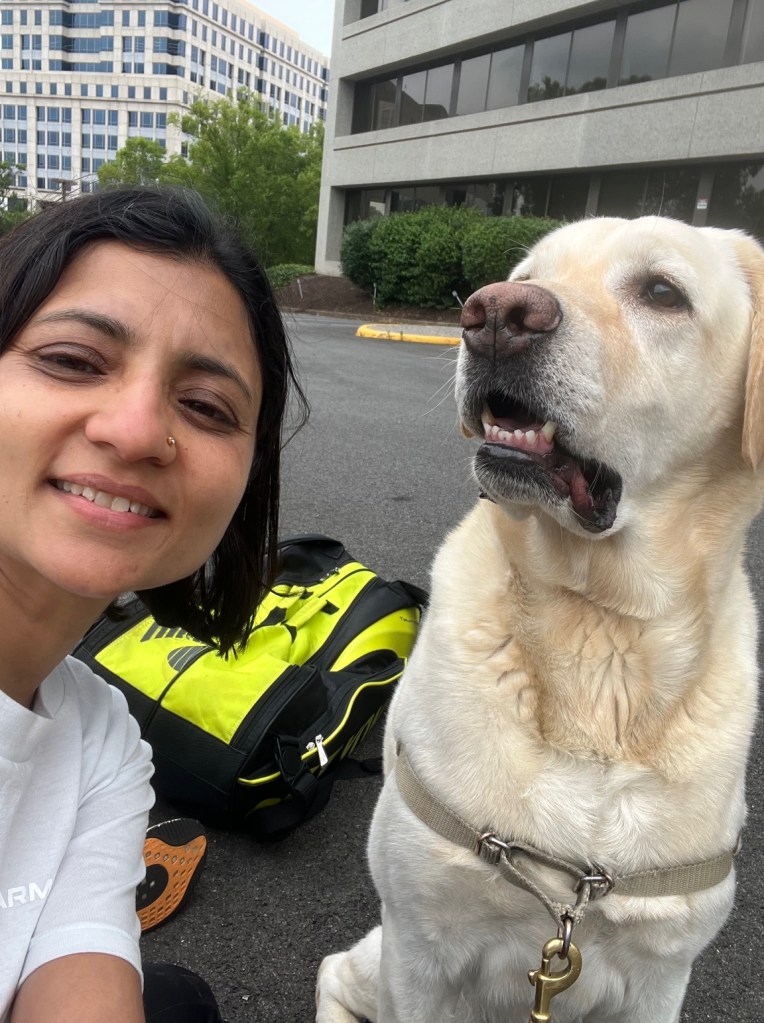
Tuffy, my golden lab, my companion for nine years, taught me something I’m still learning – how to live in the moment, how to love without conditions, how to be childlike without being self-conscious. His recent passing still feels like disbelief. It still feels like he’s gone to daycare while we’re on vacation.

This is what life is teaching us, I feel – to live like dogs do. Fully present, fully joyful, fully here.

With humans, I can’t be that way. I hold back. I perform. I worry about how I’m perceived. But with Tuffy? I could be silly. I could talk in that voice I use only for dogs, sing songs that made no sense, play games that were just ours. I could sit on the floor with him and forget about everything else.

He brought out the childlike part of me I thought I’d lost.

Tuffy didn’t need me the way I needed him. He was content. Emotionally mature. He trusted me. He didn’t need constant affection or reassurance – he just wanted to be near. I was more of a “Velcro” human to him. I’d put his bed wherever I was working, wherever I was doing things. He slept on his bed. I would just feel happy looking at him and calling out to him every now and then. In response, Tuffy would open his eyes or wag his tail, as if to say he loved me too.

And somehow, that was everything for me.

I remember how excited he’d get when I’d take him for walks, how happy he would be to welcome me every time I opened the front door and walked in. He loved bringing his toys to me and to play with him.

And I remember the last time.

Even when he was in pain – on what would be his last visit to the ER, though we didn’t know it then – he waited for me in the garage. My husband was walking with him toward the car, and I had to go back to get something. Tuffy stopped and turned to look at me. He wouldn’t budge. He turned back, waiting for me, looking out for me despite being in pain. I find that so emotional – his love for me, even in that moment. It was a habit he had. He wanted all family members to walk together with him. Not one ahead, not one behind. He found such joy in that togetherness.

What Tuffy taught me goes beyond the grief. He showed me what it means to live in presence – to find joy in simple things, to simply love, to trust without needing proof, to be fully here in each moment.

That’s the lesson. That’s what I carry forward.

Breaking the Cycle

Learning to Steep Like Tea

Somewhere in my healing journey, there was this gentle slowing down – a soft withdrawal from my usual urgency to react, to fix. Before, when I felt triggered or when sadness and panic hit, there was always this restlessness, this need to fix something, to move quickly. That place was not comfortable to be in.

What I never expected was that this slowing down was actually nature’s way of teaching me to be present. Through my trauma, I discovered this was a sign in my healing journey – that I was learning to let go and be more accepting.

One day when my best friend was asking me how I was doing, the words just came: “I’m steeping, like a tea bag in hot water.” I was surprised I even said that, because it was exactly how it felt.

Now when I need this time, I grow quieter, naturally gravitating toward solitude – long walks in nature, visits to the spa, or simply sitting on my balcony watching the sky and trees. I write sometimes, or just think, or don’t think at all. During this time, I don’t rush to process or understand. I just let whatever I’m feeling exist.

There’s something profound in this stillness. A calmness emerges that I never found in all my previous rushing toward solutions. Realizations surface naturally, like bubbles rising in still water. And in those moments, I find myself talking to my Creator – not in desperation, but in surrender.

It might take a day, sometimes longer, but eventually something shifts. There’s lightness. Clarity. A deeper understanding I couldn’t have forced. And always, always, humility.

I realize now that healing doesn’t happen through panic or the urge for immediate fixes, but through presence. Through simply being with what is, without needing to change it right away.

The most healing happens when I stop trying to heal and just… steep.

This process has taught me that sometimes the answer isn’t to do something about our emotions, but to be with them. To trust that sitting quietly with our experience, creating space for it to exist, allows something natural and necessary to unfold.

I’ve learned I need time alone with whatever I’m going through. And in that solitude, in that steeping, I find not emptiness but fullness. Not avoidance but the deepest kind of presence.

Maybe what we call healing isn’t always about getting better faster. Maybe sometimes it’s about learning to be present with ourselves exactly as we are, trusting that this presence itself transforms us in ways our rushing never could.

Choosing to Stop Chasing: A Reflection on Presence

I’ve been having recurring thoughts about a particular service that I find meaningful and purposeful – something I could extend to others. But when I looked deeper, I recognized this mental chatter for what it was. A mind that is busy and urging action often stems from the ego seeking validation, while true divine guidance feels calm, peaceful, and organically natural. If something is truly meant to be, it emerges from this place of clarity and peace – not from racing thoughts.

Through my meditation practice, I’ve learned that God speaks to us through our hearts in the present moment. When we’re completely open to the here and now, we receive what we need. Meditation helps us recognize when thoughts come from ego versus divine guidance from our Heart and makes it a choice to shift back to simply being present.

So I realized: I don’t need to chase after racing thoughts or dreams. What’s meant for me will come in the given moment. All I need to do is be here and now, accepting whatever the moment offers with grace and gratitude. When I say yes to the Creator with a thankful heart, I become clear about what needs to be done – whether it’s catering to someone’s needs, cleaning someone’s space, offering a smile to a stranger, or feeding the hungry. The form doesn’t matter; what matters is the open-hearted presence I bring to it.

Even daily planning can flow from this centered space. When we plan from the present moment, it helps quiet mental noise and allows us to be more focused, rather than anxious about outcomes.

This insight deepened while I was eating. My mind became busy with random thoughts – thinking about this, planning that, wondering if I should watch something on my phone. These thoughts were pulling me away from simply being present and respecting the food before me. Then I remembered: I don’t have to chase after things to do or think about. The moment I felt this truth in my heart, everything shifted. I became quiet, fully present with my food, relishing every bite without needing any distractions.

This revealed something profound about mental restlessness. When we’re not present, the mind becomes noisy, always seeking something to chase or think about. This restlessness comes from the ego trying to maintain control, to feel important, to avoid the beautiful simplicity of just being.

We don’t have to chase anything. When we’re truly present, serving as instruments of our Creator, everything we need is already here and now. The peace, the purpose, the next right action – it all emerges naturally from this space of open-hearted presence.

May this reflection serve as a gentle reminder to return to the present moment, to trust in divine timing, and to find peace in simply being.

Finding Myself in Silence

For years, I struggled with depression and a deep sense of loneliness. I attributed my discomfort in large groups to my traumatic childhood, believing this was the sole reason I felt so disconnected when others seemed energized by company. Others would comment on my reserved nature, making me question if something was wrong with me.

I had always been someone who could spend hours simply gazing at nature. While others found it odd, I found complete peace in these quiet moments with trees, birds, and the sky. I confused this natural inclination for solitude with depression, thinking perhaps I just wasn’t interested enough in being sociable. Yet paradoxically, I felt deeply lonely – a contradiction that tore at me. How could I both cherish solitude and yearn for connection?

Living with depression was like carrying a heavy burden – the pain, the confusion about who I was, the thoughts that wouldn’t leave me alone. To escape all of this, I often filled my moments with noise – television shows playing continuously, many podcasts one after another. Anything to avoid sitting with the silence and my own thoughts.

Then came a time when something shifted through my meditation practices and the guidance of my Spiritual Teacher. I chose to step away from these distractions and simply be with myself and our Creator, moving through household tasks in quiet presence.

In this gentle time alone, I discovered something beautiful.

There’s a depth in silence with our Creator that nothing else can match. As the usual busyness fell away, a new clarity emerged. The mental fog that often clouds our days lifted, and my heart found its way more naturally to prayer and presence.

Sadness visited too, in a way I hadn’t experienced before. But this time, I stayed with it differently – sharing openly with our Creator. My prayers became deeper, more heartfelt, asking for help with forgiveness, both to forgive and be forgiven.

Through these prayers and silence, I began to understand something profound – the recognition that living like a hermit, even while surrounded by family, can be a blessing when lived in devotion. In this quiet space, I found myself speaking less and listening more. The usual pull toward reactions softened, making it easier to turn toward divine love instead.

In these moments, I felt myself again – perhaps for the first time in lifetimes. It was different from anything I’ve known in this life. This feeling goes beyond belonging to a group or finding people who understand you.

I’ve finally accepted something about myself: I am someone who finds deeper connection in quieter ways. This love for solitude isn’t something to fix or change – it’s simply who I am. What matters isn’t the number of connections, but the ability to be fully myself, even if it’s with just one kindred spirit.