As Mental Health Awareness Month prompts us to reflect on what truly nurtures our wellbeing, I find myself thinking about relationships – specifically, the ones that, despite our best efforts, aren’t meant to last.
I recently faced this with someone who once meant a great deal to me. After experiencing hurt, I valued the relationship enough to offer peace, to make things lighter, to do my best from my end. I genuinely tried to nurture what we had, hoping we could rebuild what was lost. Yet despite these sincere efforts, I eventually realized something important: sometimes the same patterns that caused the initial hurt remain, even after forgiveness has been offered and accepted.
Some relationships naturally drift apart, as though they were never truly meant to endure. The pattern can be particularly painful: a relationship forms, hurt occurs, distance grows, forgiveness follows, reconnection happens… only for the same cycle to repeat itself months or years later.
What I’ve learned about mental health through this experience is profound. Our inner voice often whispers the truth long before we’re ready to hear it. That feeling of something not being quite right – that’s wisdom trying to protect us.
I believe that prioritizing mental health means honoring those internal signals. It means recognizing when a connection depletes rather than replenishes us. It’s not about blame or holding grudges; it’s about acknowledging the reality of what is, rather than clinging to what we hoped could be.
Not every relationship that enters our life is meant to remain there permanently. Some connections serve their purpose for a season, teaching us necessary lessons before we continue separate paths.
The most valuable lesson I’ve learned is that forgiveness doesn’t obligate us to restore a relationship that repeatedly shows itself to be unhealthy.
I don’t believe we should forget the experiences that have shaped us. Each relationship – even the painful ones – has contributed to who we are today. These moments have taught us about boundaries, about ourselves, about what we truly need from connections that deserve space in our lives.
The journey toward better mental health often involves making peace with the reality that some chapters in our story are meant to close. This isn’t failure – it’s growth.
As Mental Health Awareness Month reminds us, we must come first in our own lives.
The greatest responsibility we have is to nurture our own wellbeing. No one else carries this responsibility for us – it is ours alone.
Sometimes, protecting that wellbeing means making thoughtful decisions about which relationships deserve our continued investment, which ones should be honored from a distance, and which should be released entirely.
This is crucial to our mental health – recognizing what brings us peace versus what disturbs it, acknowledging those feelings, and honoring them instead of pushing them aside. There’s wisdom in our discomfort that deserves to be heard.
There’s profound courage in recognizing when a relationship consistently disrupts your peace. Sometimes the most compassionate choice – both for yourself and the other person – is to release the expectation that things will be different next time.
Forgiveness doesn’t always mean restoration. Sometimes, it simply means freedom – the freedom to wish someone well on their journey while continuing your own, unburdened by regret or obligation.
In honoring our mental health, we learn that some of the most important boundaries we’ll ever set are the ones that protect our peace, even when others don’t understand. And that’s not just okay – it’s essential.
What have you realized about relationships that has been crucial for your mental health? What wisdom has your journey taught you about the connection between healthy boundaries and wellbeing?
From the times of Covid when work from home became the norm, remote work has presented unique challenges, particularly in understanding and connecting with colleagues. You learn to interpret coworkers from whatever little they share during meetings or daily standups. Emotionally connecting with peers has been difficult, not to mention how crucial it is to understand each other to work effectively as a team.
Years ago, a new colleague joined our company. He sounded very sarcastic, often cutting people off and calling out mistakes in a somewhat snobbish manner when someone didn’t understand or comprehend what he shared. He quickly developed a reputation as a difficult person to work with, and very soon I had formed an opinion of him as being hard to collaborate with, intimidating, and aggressive. Let’s call him “Jacob” for privacy reasons.
With many new people joining our team at that time, I had suggested at our Retro meeting that it would help us bond if we did a casual team building exercise. I was pleased when my scrum master and manager agreed, seeing value in such an activity. My manager went the extra mile by preparing some creative questions for the team.
One question asked everyone to share something about their childhood – what was their best learning experience or what they wished they had learned better.
When Jacob’s turn came, what he shared caused a paradigm shift in how I perceived him.
Jacob revealed that he was orphaned and didn’t know his birth parents. He had moved between several foster homes as a child before being raised by an elderly couple when he was 8 years old in rural Iowa. His foster parents had a big farm with neighbors half a mile away. There weren’t many children his age nearby with whom he could relate and play. His foster parents were kind enough to teach him life skills and provide him education. He worked very hard to respect the opportunity he had and to thank his parents too.
He shared with a chuckle that due to his childhood and growing up with elderly parents, he had always struggled with connecting to people his own age. His weakness has been his awkwardness with people, and his communication style has suffered as a result. He acknowledged that he could come across as rude or too direct, but emphasized that he doesn’t do it intentionally – he’s simply struggling with it. He added that he’s actively working to improve.
Hearing him talk shifted something profound in me. It made me realize how quick we are to judge others. We don’t know their full story, and it’s true that to a great extent, our choices and behaviors are heavily influenced by our life circumstances and childhood conditioning.
While it’s important to listen to our instincts when our energy senses something or someone is not good for our mental health, we don’t need to rush to judgment or share harsh opinions. Rather, we can respect our feelings and create appropriate distance when needed, as our primary responsibility is to take care of ourselves.
We tend to waste our energy and time harboring negative feelings towards others or obsessing over “why” or “how could they” behave a certain way. This often leads us to assume things about situations unknown to us. We may never truly understand why people behave the way they do, but we can take care of our wellbeing, know our boundaries, and simply meet people where they are, keeping things uncomplicated. No one is responsible for our happiness except ourselves.
A smile to my Heart brings a Joy to my Soul. The more I meditate and give the Love to my Heart, I realize I am being Loved. My Heart reminds me of my purpose… to share and Give the Love to others, to act as Beautiful Instruments of the Divinity.
What more do I need when I am being caressed in Your Love? What more can I ask for when held in Your Grace? Here, I become speechless in Gratitude so deep… Deeper than the oceans, Deeper than the darkest nights. Oh how peaceful is this? I am one with the Divine.
My Dear Love, Please help me… In every way and all ways. As I know so little, little than the drop in the ocean. I am Your child, Your Baby. I want to be held in Your arms, be safe in Your palm. Bless my Being that I may always know I am nowhere but right here in Your arms, Where I have always been and always will be held In Your strong, embracing arms.
How deceiving is this illusion? This illusion of separation, That I am away from You, which makes me feel I am scared, on my own. Only to realize that experiencing this ego is one of the ways I realize I need You more than ever.
As every time I go deep in my ego, go very deep in my emotions, and have a clouded day that makes me feel I have nowhere to go… Makes me cry, shout and deny You all at the same time. You are right there observing me like a Mother watching its child’s tantrums with a smile that says it all. And, then when the child in me has finished its tantrums, You open Your arms so that I can run to You as Your little baby. What words do I have to explain this union?
Beloved Source of Unconditional Love, please bless me so that I am never separate from You, even during times of doubt. I do not need the ego to realize Your Love. Please help my Heart to know that every time I choose my ways, I turn away from Your Love.
Melt me in Your Love. Burn me in Your Eternal Flame. Bless my Being so that I am One with You. I surrender my will, my desires and all my efforts to You, At Your Lotus Feet. To be One with You, to be Your Instrument. Bless my Being as You melt this feeling of separateness through the thoughts and feelings of my wants, my desires and my emotions. As my Divine Love, I cannot live even those moments of feeling away from You.
In Chennai’s sweltering summer months, apartment complexes stand like their own little villages – multiple buildings rising at least 5 floors high, connected by common walkways and shared spaces. Krishna’s home sits in one such building, on the third floor, where life begins well before dawn.
By 5:30 am, the first wave of household help arrives. Women like Valli make their way through the security gate, heading to different apartments across the complex. Each building houses families on different floors, and these women have mastered the art of managing multiple households in carefully planned shifts.
A typical day for these household workers follows an unwritten but well-understood schedule. Valli, a tall and dusky woman with a warm smile, arrives early in the morning at Krishna’s home. Dressed in a simple polyester saree, her hair neatly braided, Valli handles essential morning tasks – preparing morning coffee, mopping the floors, washing clothes and tidying the kitchen. She then moves between three or four houses within the same complex, their timings synchronized with different families’ routines. Valli arrives again in the afternoon, when cooking is all done, and cleans the kitchen.
Despite working in multiple homes, these women form unique bonds with each household. In Krishna’s home, Valli found more than just employment – she found understanding, care, respect and a friend. While she dusted and mopped the floors, washed clothes, and tended to daily chores, Krishna ensured the relationship transcended the typical employer-employee dynamic.
Krishna on the left, Valli on the right
What strikes you first when you enter Krishna’s home isn’t just her booming voice or infectious laugh – it’s how the traditional hierarchy of ‘madam and maid’ dissolves at her doorstep. Her loud, cheerful ‘Good morning!’ echoes through the apartment as Valli arrives, making it clear this isn’t just another workplace.
In Chennai, where household help often moves silently through homes like shadows, Krishna’s approach stands refreshingly different. Her kitchen was just not a place where her maids had work to do but a place where dignity is served alongside meals. ‘Have you eaten properly?’ she’d ask Valli, not as a casual question but with genuine concern, understanding that a day of working across multiple homes demands energy and strength.
The transformation is visible in Valli’s demeanor. Despite her exhausting schedule – arriving at 5:30 AM after an hour’s journey, having already cooked for her own family – her tired face lights up in Krishna’s home. Here, she isn’t just someone who cleans and does chores; she’s a person whose well-being matters.
Krishna’s teasing banter, her way of checking if Valli had her morning coffee, her insistence on proper meals – these small acts show immense love, kindness and respect often missing in such relationships. When Valli developed tennis elbow, Krishna’s response wasn’t of an employer inconvenienced, but of someone genuinely worried about a person she cared for. While others might have simply reduced her workload, Krishna took action. She personally accompanied Valli to her trusted doctor, ensuring proper treatment and follow-up care. This wasn’t just about maintaining a household helper’s health – it was about caring for someone who had become part of her extended family.
During my visits, watching this dynamic unfold became a daily source of joy and learning. Seeing Valli’s warm smile, the way she moved comfortably in the space, the gentle assertiveness with which she could voice her needs – it spoke volumes about the environment Krishna had created. Despite life’s challenges, this had become Valli’s happy place, where her dignity remained intact, and her work was valued beyond the tasks she performed.
This is what makes Krishna special – her ability to transform what could be a mere transactional relationship into one of mutual respect and genuine care. In a society where class divisions often create invisible barriers, she shows how simple acts of kindness and respect can build bridges instead of walls. Krishna’s approach to treating household help with dignity isn’t limited to Valli alone; each person who works in her home finds the same warmth and respect.
This same depth of care extends to her furry family. Krishna’s love for animals manifests in remarkable ways. Her apartment, surrounded by stray cats, became a sanctuary when her son brought home Kai, a rescued kitten. This grey and white striped Bengal-like cat, with striking green big eyes, arrived traumatized but found healing in Krishna’s patient love. Even now, though Kai fears strangers and loud sounds, she finds comfort sleeping in Krishna’s arms at night.
Then there’s Rocky, the rescued Labrador with severe allergies. Krishna didn’t hesitate to adopt this 8-year-old dog, despite his medical challenges. She transformed her home to accommodate him – special bedding with multiple-layered, soft cotton blankets for his sensitive skin, specific dietary arrangements, and careful management of his interactions with the resident cats.
Despite her own health challenges, Krishna’s capacity for care seems limitless. Her personality might fill a room – loud, loving, and electric – but it’s her quiet, consistent kindness that truly defines her. Whether it’s a frightened cat, an ailing housekeeper, or a struggling dog, Krishna’s response is always the same: unwavering support and practical help.
In an age where corporate leadership often struggles to balance humanity with hierarchy, Krishna’s approach offers a simple yet profound lesson. While companies invest in leadership workshops and employee engagement programs, my sister naturally demonstrates what authentic leadership looks like in practice. Her method isn’t drawn from management textbooks but from a basic understanding: that treating people who work for us with genuine respect and care creates an environment where loyalty and dedication flourish naturally.
Each time I leave my sister’s home, I carry with me not just memories of her legendary hospitality, but profound lessons in human centered leadership. Through her, I learned that the most effective management style isn’t about power dynamics or formal protocols – it’s about acknowledging the dignity in every person who crosses our threshold. In the end, leadership isn’t about titles or power. It’s about the quiet, daily choices – choosing kindness over indifference, respect over hierarchy, and love over obligation.
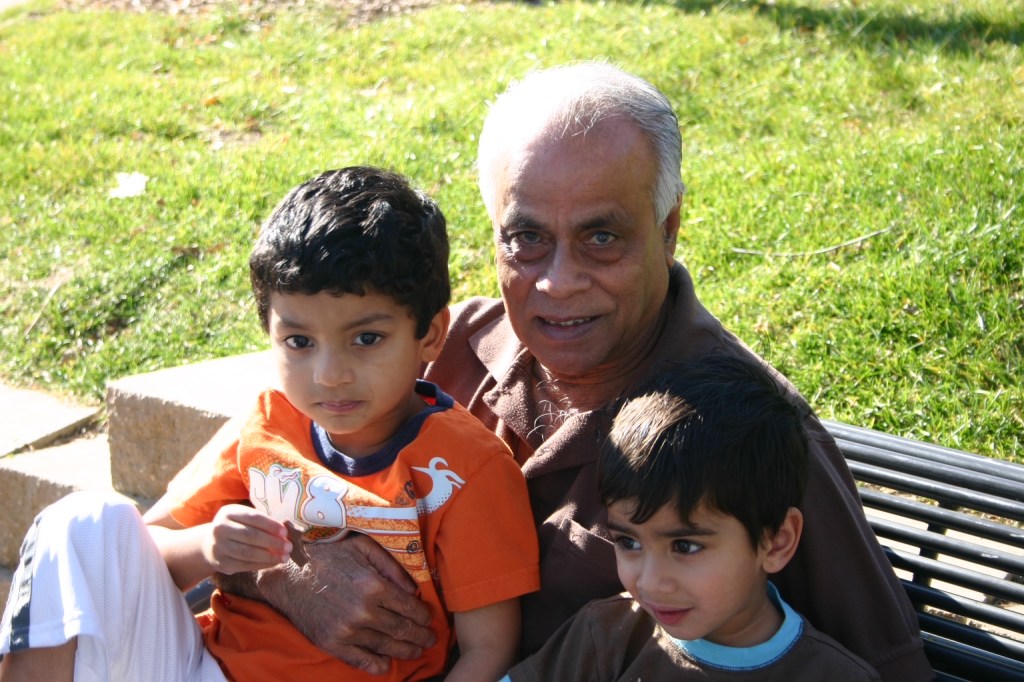
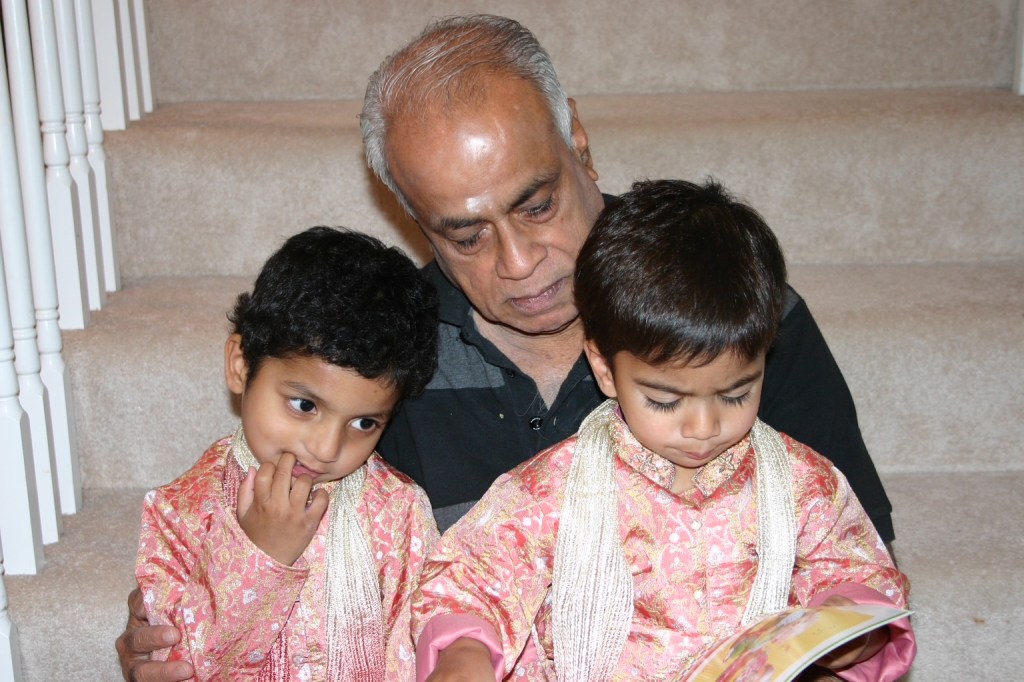
Some people have a natural gift for turning ordinary moments into memorable stories. In Appa, my husband’s father, I discovered a masterful storyteller, a passionate sports enthusiast, and a grandfather whose eyes light up at the sight of his grandchildren.
Our relationship defied traditional labels. In Appa, I found something rare and unexpected – a friendship that transcended conventional family bonds. When I first met Appa, his laughter filled the room, breaking the formalities. Over time, his quiet strength and open-heartedness turned our relationship into something deeper – built on respect and affection.
Appa stands as the pillar of warmth and wisdom in our family. His jovial demeanor and thoughtful ways have been a quiet anchor for our whole family.
As in any relationship, ours has weathered its storms. There have been disagreements and difficult moments – as natural in any family dynamic. Yet what stands out is not the challenges but how we’ve moved through them. The deep respect and love we share has only grown stronger through these tests, showing that true family bonds aren’t about perfect harmony but about choosing to understand and cherish each other despite our differences.
What strikes me most about Appa is how effortlessly he turns ordinary moments into meaningful connections. Whether sharing his written stories, organizing family gatherings, or simply being present, he weaves our family closer with each interaction. His ease in engaging anyone – regardless of age or background – reflects a deep, genuine interest in people that I deeply admire. Here is a man who wears his happiness openly, making every conversation feel like a celebration.
It’s fascinating how some people naturally turn strangers into friends. Wherever he went, Appa’s buoyant personality shone through – his cheerful eye contact and genuine smile greeting others came straight from his heart.
But Appa’s gift for connection wasn’t limited to conversations – it extended into the stories he told. His ability to draw people in, to make them feel part of something bigger, truly shone when he began to weave tales, especially for his grandchildren.
Appa has always been a man of many worlds – a storyteller, a strategist, and a quiet force of energy. Even in his 80s, his mind remains sharp, always searching for the next story to tell or game to play.
Creativity isn’t something Appa switches on and off – it’s simply a part of who he is. Whether through his vivid writing or animated conversations, his stories light up the room, turning simple moments into lively, memorable experiences. Whether it’s a tale from his childhood or a recent family anecdote, Appa has a way of painting pictures with his humor. His stories come alive with carefully chosen details, perfectly timed pauses, and that characteristic twinkle in his eye that signals a humorous turn ahead. Even stories I’ve heard before feel fresh with his skillful delivery – adding a new detail here, a different perspective there, making each retelling an adventure of its own.
Nothing captures Appa’s playful creativity better than his tale of Kaa, the clever crow – a story he told countless times to entertain his grandchildren during dinner. Yet, with every telling, he added new twists, turning it into a fresh adventure each time.
Once upon a time, high in the branches of a grand banyan tree, lived a clever crow named Kaa. His feathers shimmered like polished charcoal in the sunlight, and his sharp, black beak gleamed as he surveyed the world below. Kaa lived happily with his beloved wife, Mei, whose glossy feathers caught his eye the very first time he saw her. They built a cozy nest together and soon welcomed six lively chicks – four who looked just like Kaa and two who mirrored Mei’s graceful form.
The banyan tree echoed with the sound of their laughter and songs. Kaa loved to entertain his chicks with playful dances, while Mei patiently taught them how to flap their tiny wings and spot tasty bugs hiding in the bark.
One scorching afternoon, Kaa set off on his daily hunt, searching for the juicy worms his babies loved, and the crunchy beetles Mei favored. But no matter how hard he tried, the ground was dry and bare. Weary and parched, Kaa perched on a wooden fence, his wings drooping.
“Oh, how I wish for just a drop of water,” he sighed
Just then, something caught his eye – a clay jug sitting on a wooden table on a house’s deck. His heart leapt with gratitude! Kaa flapped over eagerly, only to peer inside and find the water far out of reach. His slender beak couldn’t dip low enough to reach even a sip.
But Kaa wasn’t one to give up easily.
Scanning the yard, he noticed small pebbles scattered across the ground. A clever idea sparked in his mind. Picking up a pebble in his beak, he dropped it into the jug. Plop! Then another. Plop! Slowly, he watched in amazement as the water began to rise.
Plop… plop… plop!
Finally, the water reached the brim. Kaa took long sips, feeling the strength return to his wings. As if by magic, right there in the garden, he spotted plump worms wriggling and shiny beetles crawling under leaves. With his beak full of treats, he soared back home, his heart light and joyful.
Back in the nest, the chicks chirped excitedly, and Mei smiled warmly. Kaa proudly shared his feast, and the family spent the rest of the day singing and dancing among the banyan leaves.
My children’s eyes would widen at each twist, their small hands holding their spoons mimicking the crow’s flight and every now and then be reminded by Appa to take the next bite as he proceeded through the story.
Appa’s voice would dip low as he described Kaa’s thirst and rise with excitement as Kaa discovered the jug and discovering the worms, and break into a triumphant tone for the journey home. My children would lean forward, completely absorbed in his theatrical narration. With his voice modulations, dramatic pauses and facial expressions – he presented a masterclass in keeping his audience engaged.
Just as he crafted stories with flair, Appa approached games and sports with the same creativity and passion. Whether through words or play, he found joy in engaging minds.
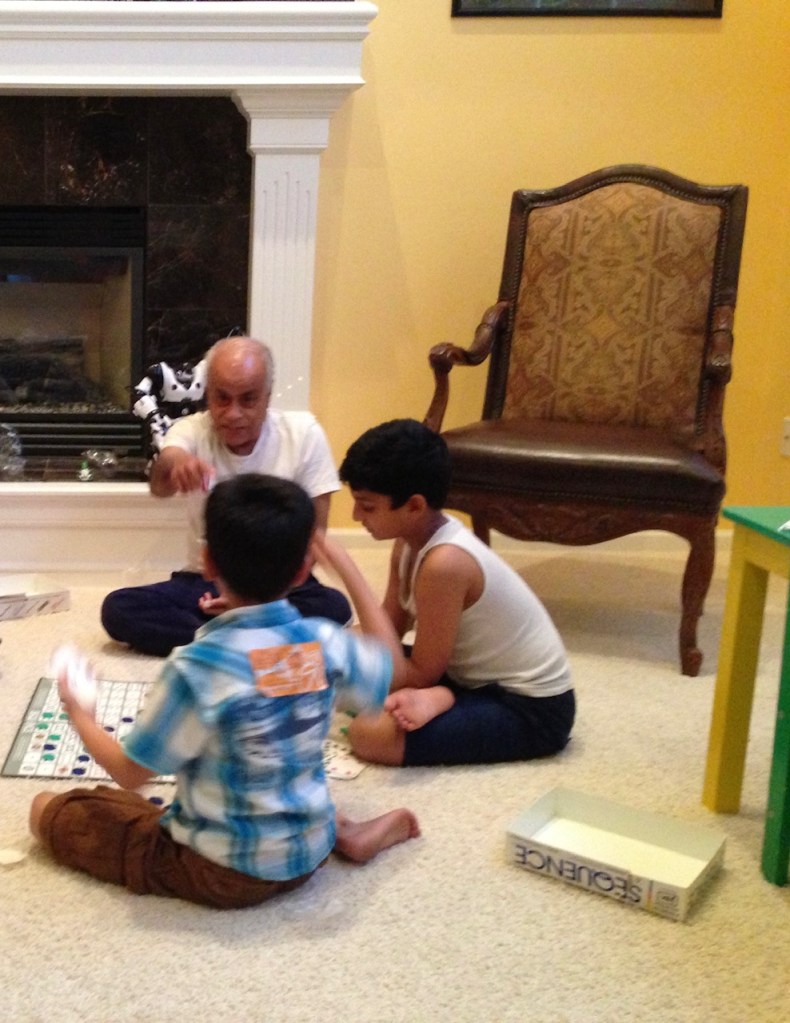
Games were never just games with Appa. Whether it was a tense chess match or a lighthearted round of cards, he played with a strategist’s mind and a child’s enthusiasm. In his younger years, he was quick on his feet with badminton, cricket and other sports, and today, he’s just as quick-witted in online chess. His love for play wasn’t just recreation – it was a way of thinking, one that his children and grandchildren carry forward.
Card games with Appa have always been more than just games – they’re chapters in our family story, blending strategy, laughter, and life lessons. Hours would slip by as cards shuffled and stories unfolded, often stretching from post-lunch into dinner during my early marriage years.
Through countless deals and shuffles, our relationship evolved from formal in-law status to something more genuine and comfortable. His systematic approach to the game – methodically arranging cards, planning moves ahead – reflected his larger approach to life and family.
Our card game sessions are like well-orchestrated performances. Appa deals with practiced precision, his fingers expertly shuffling the deck while he hums softly with a mischievous smile. Between hands, stories flow as naturally as the cards – tales of his youth, wisdom wrapped in wit, and observations that make everyone laugh.
What’s remarkable is how this playful spirit didn’t stop with him. Watching my children plot their next move in a board game or invent whimsical stories, I realize how deeply they’ve inherited Appa’s love for thinking differently and embracing challenges.
What has always left me in awe of Appa is his boundless energy and spontaneous spirit. He embraced life fully, treating every moment as a gift to be savored. Whether offering a heartfelt compliment to young or old or sharing his unfiltered thoughts, Appa has an extraordinary ability to make people feel truly seen. With him, what you saw was exactly who he was—authentic and unapologetically himself.
Even when faced with health challenges, Appa’s mind never rested. He found joy in staying engaged – whether through a game of online chess or penning down his thoughts. His unwavering integrity and commitment to his principles has guided him through life. He wasn’t afraid to speak his mind, and his words always carried weight because they came from a place of honesty and courage.
That same fearless authenticity is what drew me closer to him. It wasn’t just his stories or games that left an impression; it was how he lived – boldly, sincerely, and without pretense. It’s a trait I see reflected in his children: the courage to be themselves and the joy of embracing life fully.
Appa’s life is a vibrant example of living with purpose, staying true to oneself, and finding joy in every chapter. His energy, integrity, and spontaneity continue to inspire me and remind me that life, with all its twists and turns, is best lived with honesty and a full heart.




 lotusheartgrateful.com