After nine years with Tuffy, I felt the void. Not just his absence — but mine. He brought out the childlike part of me I thought I’d lost. I missed that. I missed that version of me.
I needed that playful love. I let myself have it.
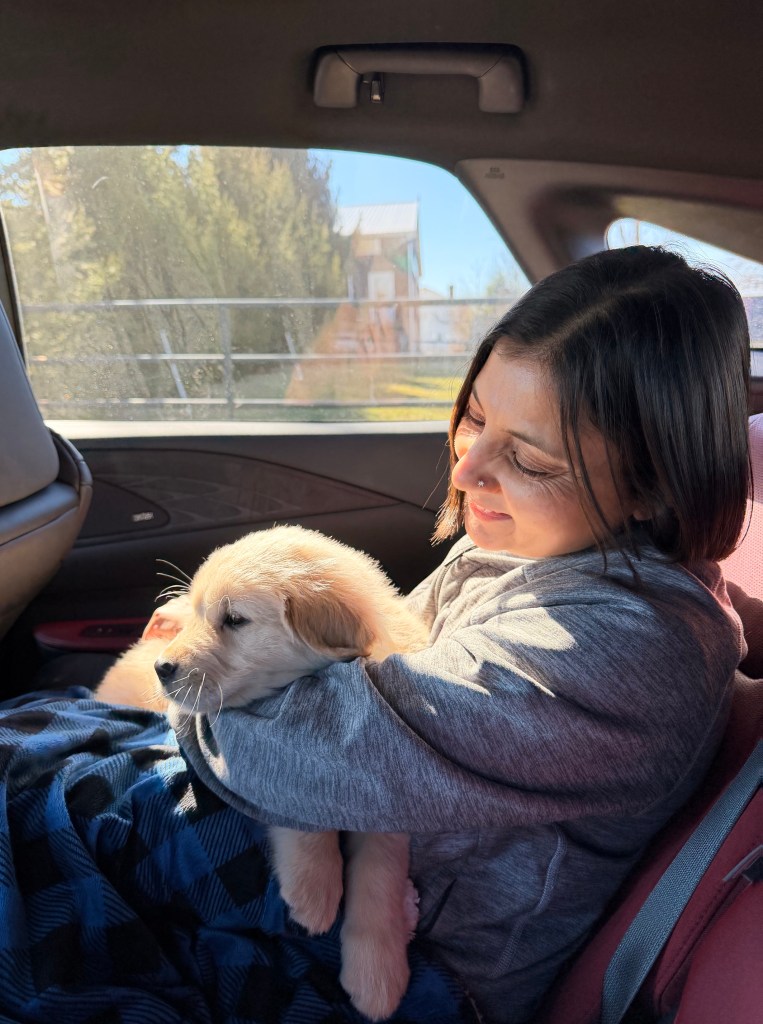
And so, Momo came in February.
This tiny, golden, ridiculously joyful being.
Grief is not a wall to get past. It is a room you learn to carry. And love — new love, next love — doesn’t knock down the walls. It builds new rooms.
Tuffy lives in memory, and it is a happy memory. When I think of him now, I smile. I feel warmth. I feel gratitude.
And Momo — my little Momo — is teaching me that joy doesn’t betray the ones we’ve lost.
Thank you, Tuffy, for showing me how to love.
Thank you, Momo, for being in my life and filling our days with your chaotic, joyful self.
The sun hadn’t even peeked through the blinds when I heard Mom’s alarm. My tail thumped against the wooden floors before I opened my eyes – morning means breakfast! I stretched out my paws, let out a big yawn, and caught the first hints of a new day.
The Tuffy Song: An Embarrassment I Secretly Love
I hear Mom’s cheerful voice, ‘Good Morning, Tuffy!’ before launching into what she calls my special Tuffy song.
It’s a… (ahem).. unique… piece of music, composed and performed exclusively by her, in a tune that I would suspect would make most dogs cringe. It goes something like this:
“Tuffy ma… Tuffy ma… Little Tuffy ma! Tuffy is a good boy, chella kutti ma…..”
I’ll spare you the rest. Human singing can be quite something.
The funny thing is, even though it’s arguably the most embarrassing song in canine history, I find myself wagging my tail every single time. Maybe it’s the way her face lights up when she sings it, or maybe it’s because deep down, I know I’m her absolute favorite. (She likes me more than Dad, and my brothers, and we both know it). I pretend to tolerate it, but between you and me – Those silly songs are our thing. Don’t tell her, I miss it when she’s too busy to sing it.
The Art of Begging: A Masterclass
Mom heads towards the kitchen, and I spring into action. I sit up, wagging my tail in slow anticipation, my best “I’m starving” look firmly in place. She knows my routine but plays hard to get, acting as though Arya’s breakfast and school lunch preparations are far more important than my needs.
I lock eyes with hers every chance I get, but I have to play it cool – too much desperation and she might start thinking I’m dramatic.
Finally, she walks towards the closet where my food is kept in a tightly closed box. (Apparently, Labrador self-restraint is a myth. One unfortunate incident involving an open food bin and a very full stomach means I’m now on a strict security protocol.)
Mom measures my food with that ridiculous little cup. Humans and their portion control – completely unnecessary. I’m a Labrador, for heaven’s sake! I have needs. The waiting is torture. A thick string of drool betrays my dignity, but who cares about dignity where food is involved?
I remember the golden days, back when Grandma used to sneak me yolks from hard-boiled eggs. It was a glorious time. Then one day, the vet called me “insanely obese” (harsh) and put me on a “healthy diet” (human talk for starvation). It was too easy to get Grandma’s attention. One “sad puppy look face”, and she would give in.
Since then, I’ve had to get creative.
Plan A: Act like I’m starving. Wag tail, sit attentively, look soulfully at food providers. Plan B: Shadow Mom. Follow her around the kitchen, strategically positioning myself near anything that could fall. Plan C: Floor patrol. Any crumbs, abandoned snacks, or overlooked morsels? I’m on it.
Does it work? Rarely. But a Lab must try.
Each family member has a role in my master food scheme:
Dad is the softie with treats.
Mom is my snack partner when no one’s looking.
Arya has a habit of “accidentally” dropping food.
Manav? The hardest to crack. The guy acts like I’m on some kind of detox program.
Bathroom Breaks & Condo Woes
After breakfast, it’s time for my morning bathroom break.
Living in a condo means my entire existence depends on humans – especially my bladder. Try explaining to your body that you live on the 11th floor and require an elevator ride just to find a patch of grass. To make matters worse, at any given time, two of the four elevators don’t work. It’s a waiting game, and let me tell you – when nature calls, that’s a game I do NOT want to play.
The elevator is its own source of entertainment. Humans are unpredictable. Some see me and turn into excited puppies themselves – ‘Oh, what a good boy! How old is he?’ Others press against the walls like I am a wild beast. (Have they even seen how adorable I am!?)
Then there was that day.
An elderly woman saw me when the doors opened on her floor and immediately let out a shriek, as if I were a ghost, and actually fell backwards! All I was doing was sitting there being my handsome self, tail wagging, saying hello.
She then proceeded to curse me in what sounded like three different languages.
Dad was horrified, I was confused. I mean, I’m a yellow lab. I’m practically a Golden Retriever’s cousin! How terrifying can I be?
The thing about humans is, they’re completely unpredictable. Some want to pet me endlessly, some act as if I’m invisible, and others treat me like I am a wolf in a Lab’s clothing.
Sidewalk Surprises: A Gourmet’s Guide to Forbidden Snacks
Now, let’s talk about my greatest passion: found food on the trails.
Mom calls it “disgusting street scraps.” I call it “sidewalk surprises.”
The moment I spot something – a half-eaten sandwich, a mysterious morsel, a bone, or my personal favorite, an abandoned piece of who-knows-what, my instincts take over.
“NO, TUFFY! NO!”
As if yelling will make me just drop this rare delicacy.
What follows is our classic Sidewalk Standoff.
Mom panics.
She tries the “drop it” negotiation tactic. (“Drop it, Tuffy! Here, have this treat!”)
I pretend to consider it. (Interesting offer, woman, but this is a once-in-a-lifetime discovery.)
I execute the “Fake Distraction Maneuver.” (Suddenly fascinated by a squirrel, I wait for her to look away…)
I chew faster.
If I’ve learned one thing in life, it’s this: Swallow first, act innocent later.
The Final Verdict: My Humans Are Pretty Darn Adorable (Mostly)
After all my adventures – food battles, elevator escapades, and sidewalk snack negotiations – the day winds down.
I listen to the familiar sounds of home:
Mom’s soft footsteps. (Probably headed to the kitchen. A potential snack opportunity.)
Dad’s heavy footsteps. (Less likely to share food, but good for belly rubs.)
Manav’s brisk footsteps. (Not worth the effort – strictest of all humans.)
Arya’s quick, fluttering steps. (Most promising. He’s my best bet for ‘accidental’ snack drop.)
As I settle in, curled up in my bed, I hear Mom humming my Tuffy song again. I let out a sigh, tail wagging a little.
Humans are a strange species – completely unpredictable and oddly obsessed with unnecessary rules.
But mine? They are pretty darn adorable.
A little stingy in food distribution, but have to admit, nobody’s perfect!
In Chennai’s sweltering summer months, apartment complexes stand like their own little villages – multiple buildings rising at least 5 floors high, connected by common walkways and shared spaces. Krishna’s home sits in one such building, on the third floor, where life begins well before dawn.
By 5:30 am, the first wave of household help arrives. Women like Valli make their way through the security gate, heading to different apartments across the complex. Each building houses families on different floors, and these women have mastered the art of managing multiple households in carefully planned shifts.
A typical day for these household workers follows an unwritten but well-understood schedule. Valli, a tall and dusky woman with a warm smile, arrives early in the morning at Krishna’s home. Dressed in a simple polyester saree, her hair neatly braided, Valli handles essential morning tasks – preparing morning coffee, mopping the floors, washing clothes and tidying the kitchen. She then moves between three or four houses within the same complex, their timings synchronized with different families’ routines. Valli arrives again in the afternoon, when cooking is all done, and cleans the kitchen.
Despite working in multiple homes, these women form unique bonds with each household. In Krishna’s home, Valli found more than just employment – she found understanding, care, respect and a friend. While she dusted and mopped the floors, washed clothes, and tended to daily chores, Krishna ensured the relationship transcended the typical employer-employee dynamic.
Krishna on the left, Valli on the right
What strikes you first when you enter Krishna’s home isn’t just her booming voice or infectious laugh – it’s how the traditional hierarchy of ‘madam and maid’ dissolves at her doorstep. Her loud, cheerful ‘Good morning!’ echoes through the apartment as Valli arrives, making it clear this isn’t just another workplace.
In Chennai, where household help often moves silently through homes like shadows, Krishna’s approach stands refreshingly different. Her kitchen was just not a place where her maids had work to do but a place where dignity is served alongside meals. ‘Have you eaten properly?’ she’d ask Valli, not as a casual question but with genuine concern, understanding that a day of working across multiple homes demands energy and strength.
The transformation is visible in Valli’s demeanor. Despite her exhausting schedule – arriving at 5:30 AM after an hour’s journey, having already cooked for her own family – her tired face lights up in Krishna’s home. Here, she isn’t just someone who cleans and does chores; she’s a person whose well-being matters.
Krishna’s teasing banter, her way of checking if Valli had her morning coffee, her insistence on proper meals – these small acts show immense love, kindness and respect often missing in such relationships. When Valli developed tennis elbow, Krishna’s response wasn’t of an employer inconvenienced, but of someone genuinely worried about a person she cared for. While others might have simply reduced her workload, Krishna took action. She personally accompanied Valli to her trusted doctor, ensuring proper treatment and follow-up care. This wasn’t just about maintaining a household helper’s health – it was about caring for someone who had become part of her extended family.
During my visits, watching this dynamic unfold became a daily source of joy and learning. Seeing Valli’s warm smile, the way she moved comfortably in the space, the gentle assertiveness with which she could voice her needs – it spoke volumes about the environment Krishna had created. Despite life’s challenges, this had become Valli’s happy place, where her dignity remained intact, and her work was valued beyond the tasks she performed.
This is what makes Krishna special – her ability to transform what could be a mere transactional relationship into one of mutual respect and genuine care. In a society where class divisions often create invisible barriers, she shows how simple acts of kindness and respect can build bridges instead of walls. Krishna’s approach to treating household help with dignity isn’t limited to Valli alone; each person who works in her home finds the same warmth and respect.
This same depth of care extends to her furry family. Krishna’s love for animals manifests in remarkable ways. Her apartment, surrounded by stray cats, became a sanctuary when her son brought home Kai, a rescued kitten. This grey and white striped Bengal-like cat, with striking green big eyes, arrived traumatized but found healing in Krishna’s patient love. Even now, though Kai fears strangers and loud sounds, she finds comfort sleeping in Krishna’s arms at night.
Then there’s Rocky, the rescued Labrador with severe allergies. Krishna didn’t hesitate to adopt this 8-year-old dog, despite his medical challenges. She transformed her home to accommodate him – special bedding with multiple-layered, soft cotton blankets for his sensitive skin, specific dietary arrangements, and careful management of his interactions with the resident cats.
Despite her own health challenges, Krishna’s capacity for care seems limitless. Her personality might fill a room – loud, loving, and electric – but it’s her quiet, consistent kindness that truly defines her. Whether it’s a frightened cat, an ailing housekeeper, or a struggling dog, Krishna’s response is always the same: unwavering support and practical help.
In an age where corporate leadership often struggles to balance humanity with hierarchy, Krishna’s approach offers a simple yet profound lesson. While companies invest in leadership workshops and employee engagement programs, my sister naturally demonstrates what authentic leadership looks like in practice. Her method isn’t drawn from management textbooks but from a basic understanding: that treating people who work for us with genuine respect and care creates an environment where loyalty and dedication flourish naturally.
Each time I leave my sister’s home, I carry with me not just memories of her legendary hospitality, but profound lessons in human centered leadership. Through her, I learned that the most effective management style isn’t about power dynamics or formal protocols – it’s about acknowledging the dignity in every person who crosses our threshold. In the end, leadership isn’t about titles or power. It’s about the quiet, daily choices – choosing kindness over indifference, respect over hierarchy, and love over obligation.
Once upon a time, in a distant realm, there was an enchanting forest. The forest, home to evergreen trees, birds of many kinds, animals, and insects, sang with beauty, happiness and mystery in its full splendor.
Tall and ancient sequoias, which had lived for thousands of years and stretched endlessly to the sky, were the eldest guardians of this forest. All the beings in the forest believed their emerald crowns could touch the heavens and sing praises of the Creator. These giants bore the wisdom of ages, having witnessed the first of many creations in the forest. Their massive trunks symbolized strength, their firm roots on Earth showed their humility. These humble giants knew every flower that bloomed, every bird that sang and understood all languages of the animals, insects and birds. All beings in the forest called them “the elders” and revered them with love and admiration.
Among these giant sequoias, Eirene was the forest’s eldest guardian. At over 4000 years old, Eirene stood tallest and wisest. On full moon nights, the whole forest gathered at her feet, where Eirene would sing songs of creation, of love, and of divine purpose.
On one such night, Eirene sang – her voice soft as rustling leaves, while all the beings listened with reverence and open hearts.
Bumble bees buzzing on golden daisies Butterflies hovering on delightful pansies Fireflies glittering in evening’s glow Dragonflies hovering in starlit snow Thank you, God, for your beautiful artistry
Zebra galloping swift and strong Deer leaping with graceful joy Monkeys swinging between trees in glee Majestic lions roaming wild and free Thank you, God, for your strength divine
Woodpeckers drumming on sturdy tree bark Owls hooting tales through moonlit dark Hummingbirds dancing with whirring wings Sparrows greeting morning as they sing Thank you, God, for this heavenly chime
Red and white roses in bloom, their passion unfold White jasmine’s intoxication, a treasure to behold Gardenia’s creamy petals whisper deep forest essence Lavender purple, calming peace in twilight presence Thank you, God, for each fragrant prayer
Nature’s symphony – wind, water, song Whispers of hidden stream that gently hum along Distant roar of waterfalls, reminding of a thunderous rain Cool breezes dancing to ease summer’s strain Thank you, God, for Earth’s eternal hymn
Listening to Eirene’s deep and soothing voice, Reya felt peace settle in his heart. Gratefully, he touched his chest with his wings, a tear dropping from his eyes. Majestic and watchful, he perched on Eirene’s ancient branches, his yellow beak shining like shimmering gold. His sharp yet gentle eyes gazed at his family nest, where his young chicks slept peacefully.
Reya had immense gratitude for the forest. In the shelter of Eirene’s roots lay the beginning of Reya’s story – an egg tossed by a mighty storm, found and protected by the entire forest. Eirene felt motherly towards this egg and whispered to her forest friends, who kept the precious egg warm and safe. When the chick hatched, Eirene named him Reya, and the forest became his first teacher.
The forest creatures became Reya’s family, each teaching him in their own way. The sparrows shared their joy of flight, the lion taught him courage in silence, and Eirene, with her ancient wisdom, became more than a teacher – she became the mother his heart needed.
As seasons passed and Reya watched his own chicks grow, a quiet sadness became to stir his heart. Each night, as the forest settled into darkness, questions about his past surfaced. Even surrounded by so much love, there was a gentle ache he couldn’t quite name – especially when he watched his little ones nestled close to their mother.
One day, Reya sat quietly on his branch, deep in thought.
Eirene noticed the sadness in Reya’s eyes and asked:
“What is in your mind, Reya?”
With his eyes lowered, Reya said:
“My heart overflows with gratitude for all I have received. You have been more than a guardian, Eirene – you and the forest have been the family I needed. You taught me not just how to live, but how to understand the Creator’s Love.”
Reya paused.
Eirene said gently,
“That is the Will of God. He wants you to be happy and ensures you get the help you need. We were just His instruments, doing what we were meant to do. Every forest creature who helped raise you was His way of holding you close. He speaks to us through the love we share. I am grateful to Him that you are grateful, my dear Reya. But tell me, what is troubling you?”
Reya looked away.
“I am grateful for everything, but lately my heart feels heavy. When I see my chicks with their mother, I can’t help but wonder about my own parents. There’s a darkness inside me I can’t shake, even though I know I should feel only gratitude. Please forgive me.”
“And, if it is in His Will that I must be happy, why does my heart still ache?” Reya asked softly.
Eirene looked at Reya with kindness as a gentle breeze stirred the air. She spoke softly,
“My dear Reya, what you’re feeling isn’t wrong. Missing your parents while being grateful for your present life – both can exist together. ”
She paused before continuing,
“The Creator gave us free will because love cannot be forced. Each challenge – each life facility – is an opportunity to choose love again. Your sadness isn’t a failure, Reya. It’s part of your journey home to Him.
Life gives us challenges – what I call life ‘facilities.’ Each difficulty is an invitation to grow closer to the Creator. Your sadness about your parents is one such ‘facility,’ a chance to deepen your understanding of true love.
My dear Reya, our Creator speaks to us from our hearts. Beneath every voice that guided you, behind every act of love from our forest family, there has always been one true Parent – our Creator. Listen to Him. When we surrender to His love, joy and peace follow.
As you meditate, you hear His voice more clearly, and you realize He is with you all the time and only we choose to move away from Him due to our own busyness and wants. The act of surrendering ourselves to Him and living each moment completely in the present brings us joy and peace. We act out His Will as we surrender to Him. It is a joy that needs to be experienced. Do not worry, Reya. I will pray to Him for your peace.”
Eireen smiled and closed her eyes for a moment in a heartfelt prayer. When she opened them, the sun was setting, painting the sky in blazing orange and soft pink. The birds chirped joyfully as they returned to their nests, bringing a sense of calm to the forest.
Eireen looked at Reya with gentle kindness and said,
“Reya, just touch your heart. Smile to your heart with the same happiness you feel when you see your chicks. Feel the gratitude. When you feel naturally at peace, close your eyes and meditate. Remember, our Creator has given us everything in this moment. Ask Him for faith, for trust. Pray to him wholeheartedly, Reya. He is always listening to you and helping you.”
Eirene closed her eyes and continued,
“Thoughts are like a web. The more we think, the more we become trapped, like a little fly. The only way out is to relax, smile and touch our Heart. Feel the Love. That Love will free you from your thoughts.”
Reya with tears in his eyes and a heart full of gratitude, said,
“Thank you Eirene. Thank you for listening to me. I feel much lighter. I will do as you say.”
With that, Reya closed his eyes and touched his heart with his wings and sat in deep silence.
Days passed, and Reya meditated each morning and evening. Slowly a gentle peace began to settle with him.
One morning, while flying far from his nest to gather food for his chicks, Reya felt something in his heart – a quiet but clear voice urging him to return home. Without hesitation, he turned back immediately.
As he approached the forest, he saw smoke rising above the trees. He flew towards the danger and discovered flames spreading through the forest. He found young birds trembling in their nests, unable to fly. Without a second thought, Reya began gathering them on his strong wings, carrying them to safety.
Flight after flight, he returned to the flames, rescuing as many as he could. The heat scorched his feathers, and his wings ached, but Reya kept going. He guided smaller creatures to shelter and refused to rest until every creature he could find was safe.
When the fire finally subsided, Reya sat quietly on Eirene’s branches. His body was tired, but his heart was light and content.
“How did you know to come back?”, asked a young sparrow that he had rescued.
Reya was silent for a moment before answering with deep gratitude,
“I heard a voice in my heart. It guided me to save our forest family. It was the voice of our Creator.”
Eirene, who had stood strong through the fire, spoke softly.
“You see, Reya, our Creator’s Love flows through our actions. Today, you were His instrument, just like when the forest creatures were His arms of protection for a lost egg.”
Reya looked at his wife and his sleeping chicks, safe in their nest. He understood now – his story wasn’t just about living but about living with purpose: to serve the Creator and extend love to others.
That night, Reya felt complete. His meditations have prepared him to trust the quiet voice of love within his heart. Reya was finally at peace, knowing his true Parents have been with him all along, residing in his heart.
As all the forest settled into a peaceful evening, Eirene sang in joy:
Praise to You, our Creator of Peace Praise to You, our Creator of Joy Praise to You, the most Powerful Praise to You, the Gentlest Praise to You, the True Source of Unconditional Love
Thank you for giving us all we need without us having to ask Thank you for being the voice in our hearts, guiding us to our True Home Thank you for forgiving us for our mistakes Thank you for healing us Thank you for loving us unconditionally
Praise to You, our Creator of Peace Praise to You, our Creator of Joy Praise to You, the most Powerful Praise to You, the Gentlest Praise to You, the True Source of Unconditional Love










 lotusheartgrateful.com