Somewhere in my healing journey, there was this gentle slowing down – a soft withdrawal from my usual urgency to react, to fix. Before, when I felt triggered or when sadness and panic hit, there was always this restlessness, this need to fix something, to move quickly. That place was not comfortable to be in.
What I never expected was that this slowing down was actually nature’s way of teaching me to be present. Through my trauma, I discovered this was a sign in my healing journey – that I was learning to let go and be more accepting.
One day when my best friend was asking me how I was doing, the words just came: “I’m steeping, like a tea bag in hot water.” I was surprised I even said that, because it was exactly how it felt.
Now when I need this time, I grow quieter, naturally gravitating toward solitude – long walks in nature, visits to the spa, or simply sitting on my balcony watching the sky and trees. I write sometimes, or just think, or don’t think at all. During this time, I don’t rush to process or understand. I just let whatever I’m feeling exist.
There’s something profound in this stillness. A calmness emerges that I never found in all my previous rushing toward solutions. Realizations surface naturally, like bubbles rising in still water. And in those moments, I find myself talking to my Creator – not in desperation, but in surrender.
“This is where I am. I need your help.”
It might take a day, sometimes longer, but eventually something shifts. There’s lightness. Clarity. A deeper understanding I couldn’t have forced. And always, always, humility.
I realize now that healing doesn’t happen through panic or the urge for immediate fixes, but through presence. Through simply being with what is, without needing to change it right away.
The most healing happens when I stop trying to heal and just… steep.
This process has taught me that sometimes the answer isn’t to do something about our emotions, but to be with them. To trust that sitting quietly with our experience, creating space for it to exist, allows something natural and necessary to unfold.
I’ve learned I need time alone with whatever I’m going through. And in that solitude, in that steeping, I find not emptiness but fullness. Not avoidance but the deepest kind of presence.
Maybe what we call healing isn’t always about getting better faster. Maybe sometimes it’s about learning to be present with ourselves exactly as we are, trusting that this presence itself transforms us in ways our rushing never could.
In daily life, whatever we do – whether we experience negativity like anger, frustration, jealousy, or hurt – I’ve come to understand that if we look deeper and deeper into our actions, we’re all seeking the same thing: peace, happiness, and contentment.
I think all that negativity is our unconscious way of trying to prove our self-worth through our ego. We demonstrate this in ways we’re not even aware of – through our struggles, our pain, our reaching for something more – all in an attempt to show that we’re worthy of love and recognition.
In my own life journey, I’ve recognized these patterns – wanting to feel seen, feeling inferior, trying to be the best at everything, people-pleasing, being self-critical, or carrying shame. Through my meditation practice and self-awareness, I’ve come a long way in understanding these tendencies. While they still show up every now and then, I can now choose differently when I notice them. We all have our own ways of unconsciously trying to prove we deserve love and happiness.
The truth is, we don’t have to do anything to earn that peace or prove our worth. It’s already within us. Our Creator loves us completely, and we have always had this love. The unconscious ways in which we try to prove our self-worth to ourselves and to others around us is never needed.
Sometimes we go through difficult experiences and learn from them. We realize that certain behaviors, thoughts, or choices aren’t bringing us the happiness we’re seeking. We start to notice that when we look for fulfillment outside ourselves – whether through hurting others, seeking power or even through self-criticism and shame – it doesn’t satisfy us. All these patterns come from the ego trying to find worth and meaning, when we already possess infinite worth simply by being.
When we observe how our life unfolds with these patterns, we can see how they affect the quality of our life and the quality of our mind. We can make different choices and turn inward instead. We can ask ourselves deeper questions about why we do what we do, why we react the way we react.
Many people don’t want to do this inner work because we’re afraid of what we might find about ourselves. We’re afraid of our shadows, our mistakes, our deeper wounds. But those questions, when we’re brave enough to ask them, can lead us deeper into self-awareness and self-discovery. It’s like removing a thorn that got deep within us. Yes, it hurts when the thorn is in, and it hurts even when we try to get it out – but we need to do it to be healed.
This process is beautiful. It’s a way of unbecoming who we think we are to discover who we were always meant to be – how we were originally created. The unbecoming process is like peeling away layers of an onion. As you go deeper, removing each layer of conditioning, fear, and false identity, you get closer to the pure essence that was always there.
This is what remains when everything else falls away – love, peace, and our true nature. We feel at peace knowing we do not have to prove anything to anyone. We feel comfortable knowing we are not perfect, and this makes it easier for us to let down our guard and accept ourselves as we are. This also enables us, as a ripple effect, to be more present and naturally accepting and loving toward others. When we are accepting of our own imperfections and loving toward ourselves, it becomes natural to extend that same acceptance and love to others. The nature of pure love is giving rather than expecting, and this changes our dynamic in relationships.
This understanding doesn’t require any special experiences or practices. It’s available to us in every moment of daily life, in every challenge, in every choice to look within rather than outside ourselves for what we’re truly seeking. Meditation practices help us through this self-awareness journey and help us become comfortable with ourselves. They allow us to see ourselves through a lens of detachment, helping us be more loving and gentler toward ourselves.
The journey inward is the journey home to who we’ve always been.
Have you ever gone to a movie theater by yourself? Bought that big bucket of popcorn, settled into your seat, and watched exactly what you wanted to see – no negotiations, no compromises? Have you ever taken yourself to your favorite restaurant, ordered your go-to dish, and simply enjoyed your own company?
I call it dating yourself. And it’s one of the most liberating things I’ve discovered in my thirties.
It all started when my bestie shared how much she loved going to theaters on her own. Something about that struck a chord in me. Her simple joy in choosing her own movie, her own time, without negotiation or compromise, inspired something in me I hadn’t realized I was missing.
My husband has always been wonderfully loving and surprising – he still is. This isn’t about lacking love in my life; it’s about discovering an additional layer of fulfillment I didn’t know I needed.
When I first tried going to a movie alone, I felt a rush of freedom I hadn’t expected. Just me, my popcorn, and exactly the story I wanted to lose myself in. The same goes for restaurants. Sitting alone at a table, ordering exactly what I’m craving, taking my time – it’s not lonely. It’s intentional. It’s caring for myself in the most direct way possible.
I used to wait for others to make my birthday special, to remember Valentine’s Day, to surprise me with thoughtful gestures. But somewhere along the way, I realized I was placing a heavy burden on the people I love – expecting them to be mind readers, to fulfill needs I hadn’t even clearly expressed.
Now? Every Valentine’s Day and every birthday, I take myself on a proper date. I plan exactly what I want to do, buy things that make me happy, celebrate who I am and who I’m becoming. It’s become my annual tradition – one I genuinely look forward to. And you know what’s beautiful about this shift? When my loved ones do surprise me – with a hug, a smile, a gift, a dinner invitation – it feels like pure joy instead of that craving or wondering within me about what they might do or give. They’ve always given out of love, but now I receive their gestures without the weight of expectation. When I do receive their loving gifts this way – already fulfilled and content – it’s pure bonus joy, free from any sense of need or demand. It makes me truly grateful for all the love I’m receiving, in a way I never was before.
I’ve learned to tell my husband exactly what would make me happy, without the guessing games. “I’d love a surprise,” I’ll say, “It could be anything.” And he delivers, every time, because there’s clarity now instead of pressure.
As I’ve gotten older, I’ve realized how crucial it is to be comfortable with our own company – not just as we age, but throughout our lives. We need to know who we are when no one else is around. We need to enjoy our own thoughts, our own interests, our own dreams.
This isn’t about becoming isolated. It’s about building a strong foundation of self-knowledge and self-care that makes us better partners, parents, and friends. When we’re not constantly running from ourselves or depending on others to fill every emotional need, we can love more freely and authentically.
When we take responsibility for our own happiness, something beautiful happens. The people in our lives can love us without the pressure of being our sole source of joy. Their gestures become gifts instead of obligations. Their presence becomes chosen rather than needed.
And when life inevitably brings changes – when children grow up and need us less, when relationships shift, when we face the natural solitude that comes with aging – we’re ready. We’ve already built a loving relationship with the person who will be with us through it all: ourselves.
I was talking to a friend recently about how much I enjoy spending time with myself, and as I spoke, I realized how transformative this journey has been. Learning to be my own companion hasn’t just made me more independent, it’s brought me a deeper peace. Less expectation, more fulfillment. I’ve become happier because I’m not waiting for others to fill a void; I’m already whole.
When I do need something from others, I simply ask. And I’m grateful that my family is supportive of this approach. There’s clarity now instead of resentment, requests instead of demands.
This is simply my story, my way of finding peace and fulfillment. I wanted to share how this approach has changed my life, how it’s helped me love the people around me more freely, and how it’s brought me to a place of genuine happiness.
When we learn to be our own providers of joy, when we stop placing the burden of our happiness entirely on others’ shoulders, something shifts. The love we receive becomes a beautiful addition to our lives rather than a desperate need.
Dating yourself isn’t about being alone; it’s about being whole. It’s about those solo movie nights, those birthday celebrations you plan with excitement, those honest conversations where you simply ask for what you want. It’s about finding that quiet confidence that comes from truly enjoying who you are.
Sometimes the most important realizations come from the simplest conversations with friends – moments when we suddenly see how much we’ve grown, how much peace we’ve found, and how beautiful it is to just be ourselves.
I must have been quite young, about 6-7 years, when I visited my father’s uncle in Adoni, a small city in Andhra Pradesh. That was the early 1980s, and their neighborhood had rows of small, tiled houses where everyone knew each other. It was a simpler time – not much of city development, just a close-knit community where neighbors seemed to care for each other. Their house was simple – a small house with a tiled roof with just three small rooms: a living room, a small kitchen, and a bedroom. What fascinated me most was the little room on the tiled roof that you could climb up to reach. It felt like a secret hideaway in that modest home.
They didn’t have a bathroom inside the house. Instead, we used the communal street bathroom. As a child accustomed to indoor bathrooms, this was genuinely difficult for me, but I managed. My parents had taught us to adjust gracefully when staying with others, to not make the hosts uncomfortable. They had shown my siblings and me that love and kindness mattered beyond anything.
Adoni Thatha (that’s how I called him) was a happy man who always lovingly addressed me as “Bangaru” (gold). He had this innocence about him and the way he laughed. He had a positivity that even as a young girl, I could feel – perhaps because I had experienced the absence of such warmth before. I felt happier around him and safe.
Looking back, I realize he was the first grandfather figure I felt connected to. Both my grandfathers had passed away before I was born. Even though we did not interact much, the time with him felt like being with my own grandfather.
What I remember most vividly is the Adoni upma that Avva (his wife, grandmother in my language) would make for me. I remember Thatha would rave about this food as it is a traditional food of the city and told me I would love it. He had asked his wife to make this for me. It is my favorite to this day. This south Indian upma was made with puffed rice that was soaked in water and drained. It was made mostly the usual way of making upma but at the end garnished with crushed roasted gram dal and roasted peanuts.
The Parrot with the Broken Wing
One of the most beautiful memories from that visit was a green parrot that Adoni Thatha cared for. This bird had fallen and broken its leg, and I watched how tenderly he took care of it. He kept the parrot in a cage to help it heal. He would take the bird out, wrap its leg with a bandage, and talk to it lovingly. He allowed me to play with the bird, and he would become like a child himself, playing and feeding it.
What touched me even more was learning later – months or maybe years after my visit – that once the parrot’s leg had completely healed, he set it free. This was one of the earliest memories I have of kindness to an animal that stayed with me. Even though he loved the bird dearly, he chose to let it fly away when it was ready. His love for the bird meant wanting it to be free.
Community Friendship
Adoni Avva was equally wonderful. I remember accompanying her as she worked with other women in the community, making cotton threads for lighting lamps in the temple. I don’t remember exactly what I did during those gatherings, but I remember I would observe how it is done and she let me weave a few cotton threads and taught me how to.
I would tag along when she went to visit her friends. As a child, I remember enjoying just observing the surroundings and soaking in the newness of the experiences.
What Children Remember
Looking back now, I realize something profound: children remember kindness above all else. Despite the uncomfortable bathroom situation, despite being in an unfamiliar place with relative strangers, what stayed with me was love.
I wasn’t there with my parents and siblings – it was just me in that small house with these caring people who made sure I felt welcomed, fed, and included. They could have seen my visit as an inconvenience, but instead they treated me, a little girl, like a treasured guest.
They took me around the community, introduced me to their world, and shared their simple but meaningful life with an open heart. In their small house, they made sure I had everything I needed to feel at home.
These memories have stayed with me, not because of any grand gesture or expensive gifts, but because of the genuine warmth I felt in that little house in Adoni. It taught me that hospitality isn’t about having the perfect home or the finest things – it’s about making someone feel truly seen, loved, and valued, and genuinely welcomed with your whole heart.
For over a year, I had been feeling this desire to feed the birds. Living in a condo without the possibility of having a bird feeder on my balcony, I felt to go to PetSmart and buy bird food and feed birds outdoors. But I didn’t act upon it – my procrastination got in the way.
Finally, last week, I felt at least this year I should do it and act upon it. And I did it. The idea came to me: why not go to the trees in front of our home, to the little park area where there are trees? Why not feed them there?
I bought a bag of bird food – dried corn, seeds, and peanuts – and began my morning routine of feeding the birds under the trees in the park area in front of our home during my walk with my dog, Tuffy. Watching them come and eat filled me with such joy.
God’s Provision for His Little Ones
This morning, I woke up a bit late and made my way to the trees around 10 AM with my bag of bird food. As I was scattering the seeds on the ground, I noticed a lady walking toward the same tree. We smiled at each other, and she asked, “Do you feed the birds?”
“Yes,” I replied, “I just started doing this recently.”
What she told me next revealed the beautiful miracle unfolding. She had been feeding these same birds for the past year. Right there, in the very tree where I had been placing food on the ground, she had three bird feeders hanging – feeders I had somehow never noticed.
With tears in her eyes, she shared that she was moving away at the end of this month. She was heartbroken thinking about the birds who had come to depend on their daily feeding. Who would take care of them? She couldn’t bear the thought of these little creatures going hungry.
And there I was – having just begun this same calling on the exact same tree, just one week ago.
“Don’t worry,” I told her, “This is taken care of. I will continue feeding them.”
In that moment, I saw so clearly how God orchestrates His care for even the smallest of His creatures. The birds would not go unfed. One instrument was preparing to leave, and another had already been called into place. The same work of love, continuing seamlessly through different hands.
As we talked more, Marianna (she graciously allowed me to share her name and our story) showed me how to properly use the bird feeders. We discovered we had so much in common – both of us believers in listening to God through our hearts, both drawn to the same spiritual language.
Marianna and me by the tree
I shared with her how there was a time when I felt deeply connected to the trees, when I would hug one particular tree daily, asking it to be my friend and give me strength – to help me become solid and humble like the tree itself, unassuming and non-presumptuous.
She smiled and said “I have a tree I hug every day too.”
How can such connections be mere coincidence?
Reflections on Divine Orchestration
This whole experience revealed such a beautiful truth to me. It’s not about me or Marianna at all – it’s about God’s tender care for these little birds. They needed to be fed, and He made sure they would be.
One instrument was preparing to leave, and another had already been prepared and placed. The same work of love continuing through different hands. How perfectly He orchestrates!
This experience reinforced what I believe: that God takes care of everything. When we stay in the moment and listen to what our heart is telling us – we become part of His plan. This is what matters most to me: trusting that God handles everything, that He knows everything, and that He is as close as we can imagine, even beyond that.
It’s important to remember and remind ourselves that this is not something we are doing – or to feel great about it. It’s humbling to realize and feel that we are just instruments in God’s hands, just as Marianna was His instrument for the past year. The birds’ needs never go unmet because God sees them, cares for them, and provides for them through willing hearts.
This is the miracle: not the human connection, but the divine provision. God’s seamless care for His creatures, ensuring that the food these birds depend on continues to come, day after day, through whoever He calls to serve. And in this calling, we discover the most intimate relationship of all – with the One who knows everything, who orchestrates everything, who is closer than close.
Thank You, God
Thank you, Marianna, for listening to your Heart and feeding these birds so lovingly, and for helping me see how beautifully God provides for His creation.
And thank you, God, for using us both in Your perfect plan to care for these little ones. Thank you for showing me that even the birds are not forgotten, and that You make sure they are fed through willing hearts.
The miracle isn’t in human connections – it’s in Your seamless, tender care for every living creature. How amazing that You would call me to continue this sweet work of feeding Your birds.
But it’s not just the birds who are taken care of. God’s love is so complete that everyone is taken care of. Marianna and I are both filled with joy, gratitude and trust in You.
Every time we hear God’s voice in our heart and act upon it, we are transformed. When we become His instruments and don’t claim responsibility for ourselves, we are changed in the humblest way. God’s love transforms everyone who is touched by it – it transforms everything connected to it.
Sometimes the most profound truths are revealed in the simplest acts: that God sees, God cares, and God provides – even for the smallest sparrow.
In a small orphanage at the edge of a busy city lived a little girl named Eva. Her dark brown curls framed her almond-colored face. While other children complained of boredom, Eva found magic in the ordinary – ants carrying crumbs in perfect lines, raindrops racing down windowpanes, dandelion seeds drifting on summer air.
Unlike the other children who felt the ache of being parentless, Eva carried a different truth in her heart. Years ago, when she was tiny and weeping because she had no parents, her teacher had knelt beside her.
“You are not an orphan, dear,” the teacher had said softly. “Your true Father and Mother live in your heart.”
Those words planted roots deep in Eva’s soul. She embraced them completely, with that pure, unquestioning faith that only children possess. Not once did doubt cloud her certainty. While other children dreamed of being chosen by new parents, Eva already knew she belonged to someone greater than any earthly parent could be.
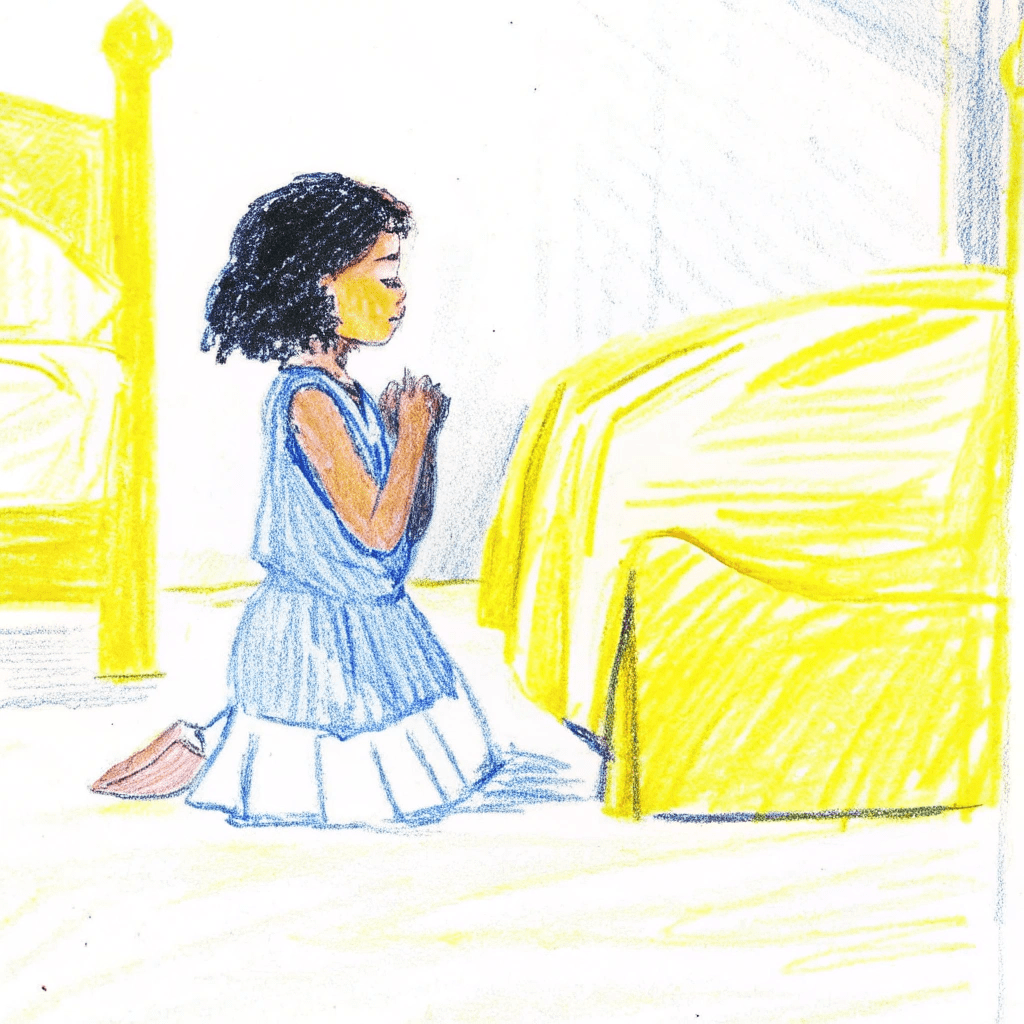
Each night, Eva knelt beside her small bed, hands folded tight in prayer. She spoke not to some faraway god but to a Father she knew listened to every whispered word:
My Father, please help me be happy My Father, please show me the way towards You My Father, please help me find my dream My Father, please help me know Your Will for me My Father, be my guide in my heart
On the night before her seventh birthday, after Eva finished her prayer, Eva asked her Father.
Father, could I hear Your voice? Could I see You, just once?
This wasn’t her doubt speaking – it was a child’s heart longing to be closer to someone beloved.
She chose her most treasured dress for the occasion – a light blue sleeveless one with white ruffle frills that touched her knees. It had come in a donation box, but somehow it fit her perfectly, as if meant just for her. She smoothed the fabric with care before climbing into bed, certain that tonight, her birthday night, she would finally meet her Father face to face.
Chapter 2: The Forest’s Welcome
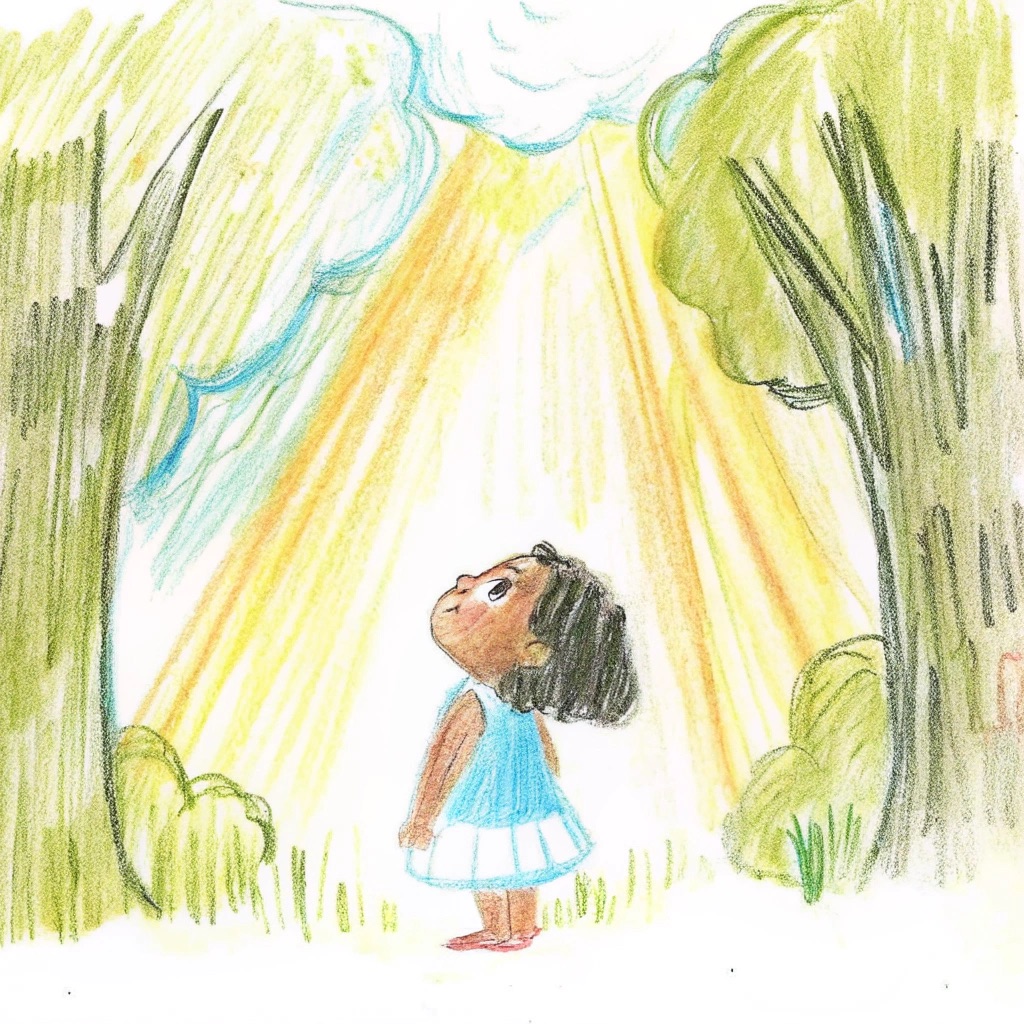
Birdsong woke her – not the usual morning chirps but something musical and intentional, like a birthday melody created just for her. Eva opened her eyes, not to peeling ceiling paint but to ancient trees dappled with golden sunlight.
Fear never touched her. Instead, she felt something like coming home after a long journey – as if the orphanage had been the dream and this forest her real home. The air filled her lungs differently here, each breath deep and sweet.
Eva understood immediately – this was extraordinary and more than a dream. This was an answer, an invitation. The feeling of love surrounding her in this place, the happiness bubbling up from somewhere deep inside – this was her Father’s presence. The forest itself spoke His love directly to her heart.
A blue butterfly landed lightly on her curls. A hummingbird buzzed close, carrying a tiny white flower in its beak, which it tucked gently into her hair. Eva giggled, delighted.
Eva sensing that the beauty around her was a language of love meant just for her, whispered:
“Thank you for inviting me, Father“
A family of deer emerged from between the trees, eyes gentle and knowing. The mother deer approached and nudged Eva’s hand with her velvety nose, then gestured with her head for the girl to follow. The fawn pranced around her excitedly, occasionally rushing back to touch noses with Eva before darting ahead again.
As they walked, Eva noticed how different this forest felt from the small park near the orphanage. The air was pure, each breath filling her with energy. The sky above showed patches of clearest blue, with clouds that seemed to hang low enough to touch, as if welcoming her presence.
In the distance, mountains stood like wise guardians, ancient and knowing. The trees along the path swayed gently, creating a refreshing breeze that carried the scent of wildflowers and old bark. And the flowers themselves – they seemed to turn toward her as she passed, their blossoms brightening, as if offering greeting.
“Everything is alive here“
Eva whispered to herself, understanding intuitively that in this place, everything was aware – conscious in ways she couldn’t fully comprehend but could certainly feel.
Chapter 3: The Garden of Wonder
As the deer family led Eva deeper into the woods, more animals began to appear. Rabbits peeked from behind ferns, squirrels paused on branches to watch her, and butterflies danced around her head.
The mother deer stopped in a patch of sunlight. She looked at Eva, then up at the trees. Eva followed her gaze.
At first, she saw only branches and leaves. But then she noticed how the leaves moved together, like they were talking to each other. The birds weren’t just flying – they were carrying messages from tree to tree.
The fawn nudged Eva’s hand and led her to a puddle of water. When she looked down, she saw not just her reflection but somehow the reflection of the entire forest. In that moment, something clicked in her heart.
“Oh,” Eva whispered. “It’s all connected.”
A bluebird landed on a nearby branch and began to sing. A rabbit thumped its foot in rhythm. Then the crickets joined in, and even the leaves seemed to rustle in time.
Eva didn’t know how, but she understood what they were telling her: Here, nothing is alone. Here, everything belongs. Here, even the smallest ant matters to the tallest tree.
She felt tears of happiness in her eyes. The animals weren’t showing her magic tricks – they were showing her the truth that had always been there, if only people had eyes to see it.
Her heart so full it could no longer contain itself, Eva began to sing. The words came to her as naturally as breathing:
Hidden treasures everywhere, In the earth and in the air. Now my eyes can truly see How we’re bound, eternally.
Father’s love flows through this place, Touching each with gentle grace. Tiny seed and mighty tree, All belong in harmony.
Thank you for this gift so rare, This secret world You chose to share. In my heart I make this vow: I’ll remember what I’ve found now.
When her song ended, the forest responded with a sudden chorus of bird calls, as if applauding. A shower of golden light filtered through the canopy above, touching her face with warmth like a loving hand.
The deer motioned with her head for Eva to follow again. Just ahead, sunlight poured into a clearing where an ancient oak spread its massive branches. Beneath it, an old man tended a garden of plants Eva had never seen before – flowers whose petals seemed to glow from within, medicinal plants whose spicy-sweet fragrances mingled and danced in the air around them. His home was a shelter crafted from interwoven branches and leaves, resembling a giant bird’s nest.
“The birds taught me how,” he would later explain to her with a smile. “They are the greatest architects of the forest.”
The old man looked up. His kind eyes showed no surprise at seeing a seven-year-old girl in a blue dress standing at the edge of his garden, accompanied by woodland creatures.
“Ah, Eva,” he said in a gentle voice. “We’ve been expecting you.”
Throughout the day, Eva experienced wonders beyond imagination. She drank nectar directly from flowers that bent toward her lips, tasted exotic fruits that grew nowhere in her known world, and helped the old man prepare a simple lunch of forest vegetables with lemon and creamy milk made from forest nuts that tasted divine.
“Why is there so much food?” she asked, watching animals come and go, each taking only what they needed.
“In this place,” the old man explained, “there is always enough. No being claims more than they require, and so no being ever lacks. The animals are not lesser than humans here – indeed, in many ways, they understand better how to live in harmony with creation.”
Chapter 4: Father’s Voice
As evening approached, the clouds above the clearing parted, and warm, golden light poured down like honey. Eva felt wrapped in something she couldn’t see but could certainly feel – love, pure and simple.
A voice spoke to her, not through her ears but straight to her heart:
“Few children ever find this place, Eva. You’ve come because your heart has always been open to love.”
Eva stood still, breathing in the golden light. She noticed it dancing around the edges of her blue dress.
“My sweet child,” the voice continued, warm as summer sunshine, “you look so pretty in your special dress. Did you wear it just for me?”
Eva nodded, her face breaking into a delighted smile.
“It’s my favorite,” she whispered. “I wanted to look nice when I met you.”
When the voice fell quiet, Eva gathered her courage. The question she’d wondered about for so long finally found its way out.
“What would you like me to call you?” she asked softly.
“What would you like me to call you?” she asked softly.
A feeling like a gentle smile surrounded her.
“People call me by many names. You can use any that feels right to you.”
Eva thought for a moment, her fingers fidgeting with the ruffle on her dress. Looking up into the golden light, she asked,
“Can I call you my Father?”
The light glowed brighter, like a sunrise.
“I am your Father, Eva. I always have been.”
Tears filled her eyes, happy tears that rolled down her cheeks. For a long moment, she simply stood there, letting the words sink deep.
The light shifted, like someone kneeling down to be at her level.
“You’re wondering about going back, aren’t you?” the voice said gently. “About how to find your way when you return to the orphanage.”
Eva looked up in surprise.
“How did you know what I was thinking?”
“I’m always with you, little one. I know you better than you know yourself.”
She nodded, suddenly shy.
“When I go back… how will I hear you talking to me like this?”
The light seemed to come closer, like a father embracing his child in his arms.
“My voice is quieter there, but it’s still the same voice,” her Father explained. “When you feel peace inside even when things are hard outside, that’s me speaking to you. When you know something is right deep in your heart, that’s me guiding you. Just stay open, like these flowers that always turn toward the sun.”
“But what if someone is mean to me?”
Eva asked, thinking of one of the older girls who sometimes pulled her hair.
“What if I need help and I can’t hear you?”
The light wrapped around her like a warm blanket.
“I’m with you even then, Eva. Sometimes being brave means walking away. Sometimes it means finding someone who can help you. Love doesn’t mean letting others hurt you – it means finding the wisest way forward. When you’re not sure what to do, just get quiet inside and listen. I’ll always find a way to guide you.”
Eva looked at the light around her and smiled.
“Father,” she asked, “in my prayers I always ask to know Your will for me. What is it that You want me to do with my life?”
Her Father’s presence seemed to brighten around her.
“My Will for you, dear one, is simple: to love and be grateful. To see the world as you see it now, with everything connected. To do all things from your heart, whether they seem big or small. When you wash dishes, do it with love. When you help someone, do it with your whole heart. And always remember to be thankful – for the sunrise, for a kind word, for the air you breathe.”
The light gently touched her cheek, like a parent wiping away an unshed tear.
“I don’t need you to do any one specific thing, Eva. I only ask that you bring love and gratitude to everything you do. Your unique way of seeing beauty in simple things is already a gift to the world.”
Eva pondered this for a moment. Then, looking down at her small hands, she asked her next question.
“Father, I’m just a little girl,” she said. “What difference can I make in such a big world?”
“That doesn’t matter, beloved child. What matters is what you choose in each moment. Every choice creates ripples that spread farther than you’ll ever see.
The results of your choices aren’t yours to control. Once you’ve chosen with love, let go of what happens next. The outcome isn’t yours to keep – it was never yours.
A single kind word to someone hurting might save a life you’ll never meet. Standing for truth might spark courage in hearts unknown to you. The smallest act of love ripples outward endlessly, touching shores you’ll never visit.
This is peace – to act with love and then release all attachment to what comes of it. This is how even a little girl becomes light in a shadowed world.”
Eva felt something heavy lift from her shoulders. She didn’t have to fix everything – just do her small part with love.
Looking up into the golden light, she asked her final question, the one she’d wondered about most of all.
“How will I see you when I go back?”
The light grew softer, and her Father answered in words that seemed to sing:
I’m in the love that fills your heart, In happiness that makes you smile. I’m in your faith that never wavers, In your surrender, filled with trust.
When you share kindness with all beings, From tiniest ant to tallest tree, That’s when you see me most clearly – In love that flows abundantly.
Look for me in passing clouds, In birds that soar on gentle wing. I dwell in people all around you, In every plant and living thing.
I live within the smallest atom, While universes rest in me. I’m found in kindness and compassion, In all the goodness you can see.
I’m in your courage when life’s hard, In strength that helps you stand. I’m in the calm that finds your heart, When dark thoughts cloud your mind.
I flow within your very blood, child, And in each breath that gives you life. Open your heart to feel my presence – I’m always here, in joy and strife.
Eva closed her eyes, letting the words wash over her. When she opened them again, she saw the forest differently – every leaf, every creature, every ray of sunlight now shimmered with her Father’s presence.
“I see you now,” she whispered, “everywhere.”
Chapter 5: The Inner Light
From the golden light descended a pendant with an emerald stone that seemed to hold the forest’s essence within its depths. A delicate chain formed itself around the stone and gently floated toward Eva, settling around her neck. The pendant came to rest against her heart, warm and pulsing with the same rhythm as her own heartbeat.
“As you asked in your prayers, my will for you is to experience your world with love and kindness, sharing creation’s beauty with all you meet. This pendant will remind you of what you’ve seen here – a secret knowledge to carry in your heart.”
The golden light gradually faded, leaving Eva standing in the clearing with the emerald pendant warm against her skin, glowing with an inner light that matched her heartbeat.
The old gardener approached, kneeling down to her level and placing his weathered hands gently on her shoulders. His eyes held the same loving warmth she’d felt in God’s presence.
“It is time to return, sweet heart,” he said softly, drawing her into a gentle hug that felt like a blessing.
When he released her, he motioned with a loving sweep of his arm toward the wolf pack waiting silently at the clearing’s edge.
“They will guide you safely home.”
The largest wolf, silver-furred with amber eyes, bowed its head low. Eva followed the wolves through the twilight forest, her heart full of wonders seen and wisdom given.
She woke the next morning in her small orphanage bed. For a moment, she thought it had all been a beautiful dream – until she felt something heavy and warm against her chest. Looking down, she found the emerald pendant, glowing with an inner light that only she could see.
Eva smiled, tucking the pendant beneath her dress. Its origin would remain her secret, but its message she would share through how she lived – with kindness, with wonder, and with a heart surrendered to a wisdom greater than her own.
From the times of Covid when work from home became the norm, remote work has presented unique challenges, particularly in understanding and connecting with colleagues. You learn to interpret coworkers from whatever little they share during meetings or daily standups. Emotionally connecting with peers has been difficult, not to mention how crucial it is to understand each other to work effectively as a team.
Years ago, a new colleague joined our company. He sounded very sarcastic, often cutting people off and calling out mistakes in a somewhat snobbish manner when someone didn’t understand or comprehend what he shared. He quickly developed a reputation as a difficult person to work with, and very soon I had formed an opinion of him as being hard to collaborate with, intimidating, and aggressive. Let’s call him “Jacob” for privacy reasons.
With many new people joining our team at that time, I had suggested at our Retro meeting that it would help us bond if we did a casual team building exercise. I was pleased when my scrum master and manager agreed, seeing value in such an activity. My manager went the extra mile by preparing some creative questions for the team.
One question asked everyone to share something about their childhood – what was their best learning experience or what they wished they had learned better.
When Jacob’s turn came, what he shared caused a paradigm shift in how I perceived him.
Jacob revealed that he was orphaned and didn’t know his birth parents. He had moved between several foster homes as a child before being raised by an elderly couple when he was 8 years old in rural Iowa. His foster parents had a big farm with neighbors half a mile away. There weren’t many children his age nearby with whom he could relate and play. His foster parents were kind enough to teach him life skills and provide him education. He worked very hard to respect the opportunity he had and to thank his parents too.
He shared with a chuckle that due to his childhood and growing up with elderly parents, he had always struggled with connecting to people his own age. His weakness has been his awkwardness with people, and his communication style has suffered as a result. He acknowledged that he could come across as rude or too direct, but emphasized that he doesn’t do it intentionally – he’s simply struggling with it. He added that he’s actively working to improve.
Hearing him talk shifted something profound in me. It made me realize how quick we are to judge others. We don’t know their full story, and it’s true that to a great extent, our choices and behaviors are heavily influenced by our life circumstances and childhood conditioning.
While it’s important to listen to our instincts when our energy senses something or someone is not good for our mental health, we don’t need to rush to judgment or share harsh opinions. Rather, we can respect our feelings and create appropriate distance when needed, as our primary responsibility is to take care of ourselves.
We tend to waste our energy and time harboring negative feelings towards others or obsessing over “why” or “how could they” behave a certain way. This often leads us to assume things about situations unknown to us. We may never truly understand why people behave the way they do, but we can take care of our wellbeing, know our boundaries, and simply meet people where they are, keeping things uncomplicated. No one is responsible for our happiness except ourselves.
One fine day, I see saggy eyes, wrinkles on my skin Where were you before? Is it stress, is it my tiredness, is it my depression? That brought you to me. Being noticed not just by me but by family I realize I may be growing older.
Is this how getting old presents itself to me? Witnessing a silver hair Fatigue visiting more often Metabolism slower, body shape unpredictable Seeing younger men and women as my own kids Sometimes a reason for my excuse for stillness.
As time went by, I realize the abuse, neglect and being ungrateful My body has gone through because of me I feel remorseful, sorry, but I cannot change my past She has traveled with me for 46 years non-stop and continues.
I thank you, my divine abode, for providing me the space where my life can live in. You are a gift given by Him You were made just perfect in His eyes I ask for forgiveness from you and promise I will take care of you, To serve you, nurture you in gentleness and humility In gratitude for you as you are His blessing to me.
Thank you for this outer skin you have given me To protect the inner body from heat, germs and things not good for my life in you I promise to be present as my skin is touched with gentleness and love As I bathe and do my skin rituals To ensure my skin feels nourished and happy Not for others to compliment or pass me a second look in wonder But for me to ensure you are happy inside and out.
Thank you for giving me the appetite So I know I must eat so you are nurtured I promise to eat healthy Unprocessed food, greens, vegetables and fruits Plenty of water for hydration Not for me to lose weight or look in a certain way But for you to be happy and healthy, So that my life in you can live a minute more.
Thank you for the bones, muscles and organs That function and that work as magic To carry the life in me forward So I have another moment of living I promise to take care of you Through my walks, jogging, exercise Lifting weights so your muscles do not weaken For me to ensure you feel strong and happy.
Thank you, God, for this beautiful body To choose You through my actions this lifetime Giving me another chance This body being one of the most beautiful miracles created by You.
Dear God, please give me the mind, realizations, intention To only choose You To be grateful, loving to my body and all the gifts You have given me To live each day with purpose and meaning Using this most precious gift given to me by You.
Happily walking towards my mom’s car, Orange leash tethered to my harness. Walking sideways with a wiggle and joy, I hear my mom opening the car with her keys.
“Ready, Tuffy? Jump!”
I finally figured the way in, that is right. Sitting in the rear seat of my mom’s car, A little whine and she understands. Mom lowers the windows just for me.
Cool fresh breeze tickling my whiskers, Smelling Spring’s sweet air. Shedding season it is, but I don’t mind, My scent is strong, Mom reminds me all the time!
Riding on my mom’s car at the back seat, Adventures with her are always unique. The last time she tried the small trunk instead, I tumbled down when the door opened wide. Pressed against the door like jam in a jar, Poor mom felt guilty – that went too far!
My hair floats free in golden clouds, Dancing in sunlight like summer dreams. Mom wrinkles her nose but I don’t know why. The smell of the car mixed with spring’s delight, the feel of breeze caressing my fur, pure joy I cannot hide.
The sounds of vehicles passing by, A rock music to my ears under the spring blue sky. The people who wave at me as we drive along, Their friendly waves make my tail wag with glee. The dogs in other cars catching my eye, Some friendly and some shy as we pass by.
Sometimes I bark at dogs we pass by, Some get a wag, others a fierce “Hi!” Mom laughs at my selective hellos, The way I choose friends, nobody knows. So many humans smile when they see my face, My Labrador joy spreads all over the place.
My nose pressed to the window glass, Taking in scents as landscapes pass. Mom says, “Tuffy, you smell so bad!” I tilt my head – why is she sad? I notice her cracking the window more wide, As I continue enjoying the ride!
At traffic lights, I sit up tall, Gazing at people and places we pass by.
Where are we going? I wonder with glee, Our favorite trails with trees to see? Is it the wooded trail where squirrels play? Or just a simple neighborhood walk today? Perhaps the groomer’s where I happily recline, The brushing and pampering feeling simply divine!
Each place holds joy, each trip a treat, With mom beside me, life is sweet!
Five years into our journey together, You joined our family, changing us forever.
The Beginning
Ecstatic to know new life grew within, The changing shape, a joy I’d never been. Though skinny all my life before this time, Each flutter in my womb felt so sublime. Cravings strange and new consumed my days, The sweets I sought – now your beloved ways.
March light was shining when you came to be, When placed within my arms, all pain set free. A joy so deep, no words could ever convey, Your serious eyes, my father’s look at play. A legacy continued, wise and true, A story spanning generations through you.
Little Explorer
As a toddler quiet, rarely did you cry, Drawers and cupboards caught your watchful eye. The kitchen was your playground, full of charms, Utensils scattered freely by your arms. On dishwasher doors perched with pure delight, Forks and spoons in vents – a puzzling sight. We’d rush our chores before you’d hear and run, Your ears so sharp, determined, quick to come. Unstoppable your spirit, bright with fun.
Growing Mind
Your childhood days were focused, sharp, precise, With puzzles, presidents, and Legos to entice. So trusting was your heart, so kind your way, Your brother’s tricks you’d fall for day by day. We captured every moment, smile and tear, Each memory a treasure we hold dear.
Compassionate Teen
As teenage years arrived, your heart stayed true, Birthdays at shelters showing what you’d do. “Bring food, not gifts,” you’d tell your friends with care, Your simple giving spirit, rich and rare. You taught us how compassion lights the way, Your wisdom far beyond your years each day.
Letting Go
Now independent, strong you’ve grown to be, Though part of me would keep you close to me. Sometimes I wish to pull you back within, With love I’ve learned to let your spirit win. Your happiness, the gift I’m thankful for, As you explore what life has held in store.
From our safe nest you’ve flown to distant halls, A college journey heeding learning’s calls. Each month we meet, our arms stretched wide to hold The man you’re fast becoming, brave and bold.
The Man Today
Still focused, loving, steadfast in your ways, Unconditional our love through all your days. We thank you for the person that you are, A guiding elder brother, like a star, Supporting siblings with your gentle hand, A role you’ve always seemed to understand.
Forever Love
My baby, boy, and man—all three in one, From heartbeats beneath my skin to who you’ve become. A young man standing tall with strength and grace, My love grows deeper as you set your pace. Know that your mother’s heart is always near, Through triumphs bright or mistakes made from fear.
Twenty years of watching wonder grow, Twenty years of love that overflows, Twenty years of memories we treasure so, And countless more as life continues to unfold.









 lotusheartgrateful.com