
Chapter 1: The Prayer
In a small orphanage at the edge of a busy city lived a little girl named Eva. Her dark brown curls framed her almond-colored face. While other children complained of boredom, Eva found magic in the ordinary – ants carrying crumbs in perfect lines, raindrops racing down windowpanes, dandelion seeds drifting on summer air.
Unlike the other children who felt the ache of being parentless, Eva carried a different truth in her heart. Years ago, when she was tiny and weeping because she had no parents, her teacher had knelt beside her.
“You are not an orphan, dear,” the teacher had said softly. “Your true Father and Mother live in your heart.”
Those words planted roots deep in Eva’s soul. She embraced them completely, with that pure, unquestioning faith that only children possess. Not once did doubt cloud her certainty. While other children dreamed of being chosen by new parents, Eva already knew she belonged to someone greater than any earthly parent could be.
Each night, Eva knelt beside her small bed, hands folded tight in prayer. She spoke not to some faraway god but to a Father she knew listened to every whispered word:
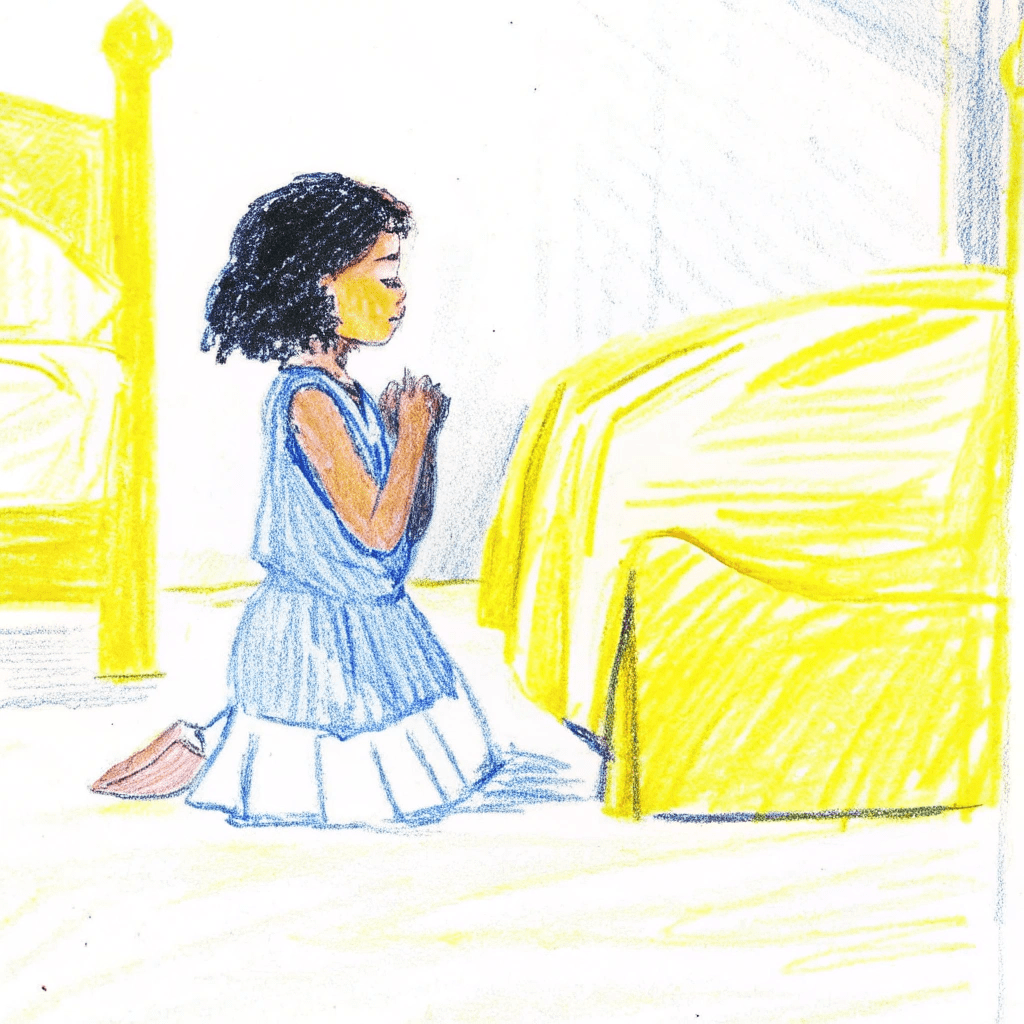
My Father, please help me be happy
My Father, please show me the way towards You
My Father, please help me find my dream
My Father, please help me know Your Will for me
My Father, be my guide in my heart
On the night before her seventh birthday, after Eva finished her prayer, Eva asked her Father.
Father, could I hear Your voice? Could I see You, just once?
This wasn’t her doubt speaking – it was a child’s heart longing to be closer to someone beloved.
She chose her most treasured dress for the occasion – a light blue sleeveless one with white ruffle frills that touched her knees. It had come in a donation box, but somehow it fit her perfectly, as if meant just for her. She smoothed the fabric with care before climbing into bed, certain that tonight, her birthday night, she would finally meet her Father face to face.

Chapter 2: The Forest’s Welcome
Birdsong woke her – not the usual morning chirps but something musical and intentional, like a birthday melody created just for her. Eva opened her eyes, not to peeling ceiling paint but to ancient trees dappled with golden sunlight.
Fear never touched her. Instead, she felt something like coming home after a long journey – as if the orphanage had been the dream and this forest her real home. The air filled her lungs differently here, each breath deep and sweet.
Eva understood immediately – this was extraordinary and more than a dream. This was an answer, an invitation. The feeling of love surrounding her in this place, the happiness bubbling up from somewhere deep inside – this was her Father’s presence. The forest itself spoke His love directly to her heart.
A blue butterfly landed lightly on her curls. A hummingbird buzzed close, carrying a tiny white flower in its beak, which it tucked gently into her hair. Eva giggled, delighted.
Eva sensing that the beauty around her was a language of love meant just for her, whispered:
“Thank you for inviting me, Father“

A family of deer emerged from between the trees, eyes gentle and knowing. The mother deer approached and nudged Eva’s hand with her velvety nose, then gestured with her head for the girl to follow. The fawn pranced around her excitedly, occasionally rushing back to touch noses with Eva before darting ahead again.
As they walked, Eva noticed how different this forest felt from the small park near the orphanage. The air was pure, each breath filling her with energy. The sky above showed patches of clearest blue, with clouds that seemed to hang low enough to touch, as if welcoming her presence.
In the distance, mountains stood like wise guardians, ancient and knowing. The trees along the path swayed gently, creating a refreshing breeze that carried the scent of wildflowers and old bark. And the flowers themselves – they seemed to turn toward her as she passed, their blossoms brightening, as if offering greeting.
“Everything is alive here“
Eva whispered to herself, understanding intuitively that in this place, everything was aware – conscious in ways she couldn’t fully comprehend but could certainly feel.
Chapter 3: The Garden of Wonder
As the deer family led Eva deeper into the woods, more animals began to appear. Rabbits peeked from behind ferns, squirrels paused on branches to watch her, and butterflies danced around her head.
The mother deer stopped in a patch of sunlight. She looked at Eva, then up at the trees. Eva followed her gaze.
At first, she saw only branches and leaves. But then she noticed how the leaves moved together, like they were talking to each other. The birds weren’t just flying – they were carrying messages from tree to tree.
The fawn nudged Eva’s hand and led her to a puddle of water. When she looked down, she saw not just her reflection but somehow the reflection of the entire forest. In that moment, something clicked in her heart.
“Oh,” Eva whispered. “It’s all connected.”
A bluebird landed on a nearby branch and began to sing. A rabbit thumped its foot in rhythm. Then the crickets joined in, and even the leaves seemed to rustle in time.
Eva didn’t know how, but she understood what they were telling her: Here, nothing is alone. Here, everything belongs. Here, even the smallest ant matters to the tallest tree.
She felt tears of happiness in her eyes. The animals weren’t showing her magic tricks – they were showing her the truth that had always been there, if only people had eyes to see it.
Her heart so full it could no longer contain itself, Eva began to sing. The words came to her as naturally as breathing:

Hidden treasures everywhere,
In the earth and in the air.
Now my eyes can truly see
How we’re bound, eternally.
Father’s love flows through this place,
Touching each with gentle grace.
Tiny seed and mighty tree,
All belong in harmony.
Thank you for this gift so rare,
This secret world You chose to share.
In my heart I make this vow:
I’ll remember what I’ve found now.
When her song ended, the forest responded with a sudden chorus of bird calls, as if applauding. A shower of golden light filtered through the canopy above, touching her face with warmth like a loving hand.
The deer motioned with her head for Eva to follow again. Just ahead, sunlight poured into a clearing where an ancient oak spread its massive branches. Beneath it, an old man tended a garden of plants Eva had never seen before – flowers whose petals seemed to glow from within, medicinal plants whose spicy-sweet fragrances mingled and danced in the air around them. His home was a shelter crafted from interwoven branches and leaves, resembling a giant bird’s nest.
“The birds taught me how,” he would later explain to her with a smile. “They are the greatest architects of the forest.”
The old man looked up. His kind eyes showed no surprise at seeing a seven-year-old girl in a blue dress standing at the edge of his garden, accompanied by woodland creatures.
“Ah, Eva,” he said in a gentle voice. “We’ve been expecting you.”
Throughout the day, Eva experienced wonders beyond imagination. She drank nectar directly from flowers that bent toward her lips, tasted exotic fruits that grew nowhere in her known world, and helped the old man prepare a simple lunch of forest vegetables with lemon and creamy milk made from forest nuts that tasted divine.
“Why is there so much food?” she asked, watching animals come and go, each taking only what they needed.
“In this place,” the old man explained, “there is always enough. No being claims more than they require, and so no being ever lacks. The animals are not lesser than humans here – indeed, in many ways, they understand better how to live in harmony with creation.”
Chapter 4: Father’s Voice
As evening approached, the clouds above the clearing parted, and warm, golden light poured down like honey. Eva felt wrapped in something she couldn’t see but could certainly feel – love, pure and simple.
A voice spoke to her, not through her ears but straight to her heart:
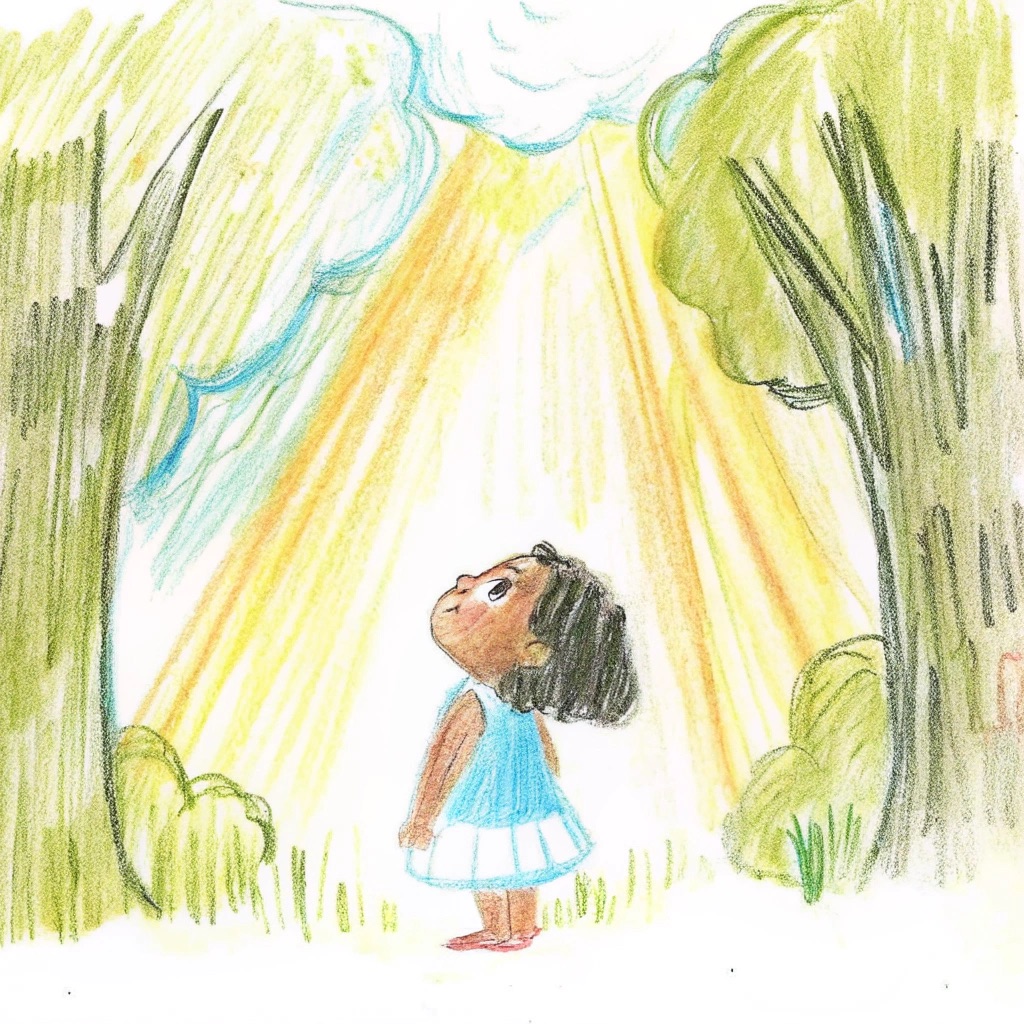
“Few children ever find this place, Eva. You’ve come because your heart has always been open to love.”
Eva stood still, breathing in the golden light. She noticed it dancing around the edges of her blue dress.
“My sweet child,” the voice continued, warm as summer sunshine, “you look so pretty in your special dress. Did you wear it just for me?”
Eva nodded, her face breaking into a delighted smile.
“It’s my favorite,” she whispered. “I wanted to look nice when I met you.”
When the voice fell quiet, Eva gathered her courage. The question she’d wondered about for so long finally found its way out.
“What would you like me to call you?” she asked softly.
“What would you like me to call you?” she asked softly.
A feeling like a gentle smile surrounded her.
“People call me by many names. You can use any that feels right to you.”
Eva thought for a moment, her fingers fidgeting with the ruffle on her dress. Looking up into the golden light, she asked,
“Can I call you my Father?”
The light glowed brighter, like a sunrise.
“I am your Father, Eva. I always have been.”
Tears filled her eyes, happy tears that rolled down her cheeks. For a long moment, she simply stood there, letting the words sink deep.
The light shifted, like someone kneeling down to be at her level.
“You’re wondering about going back, aren’t you?” the voice said gently. “About how to find your way when you return to the orphanage.”
Eva looked up in surprise.
“How did you know what I was thinking?”
“I’m always with you, little one. I know you better than you know yourself.”
She nodded, suddenly shy.
“When I go back… how will I hear you talking to me like this?”
The light seemed to come closer, like a father embracing his child in his arms.
“My voice is quieter there, but it’s still the same voice,” her Father explained. “When you feel peace inside even when things are hard outside, that’s me speaking to you. When you know something is right deep in your heart, that’s me guiding you. Just stay open, like these flowers that always turn toward the sun.”
“But what if someone is mean to me?”
Eva asked, thinking of one of the older girls who sometimes pulled her hair.
“What if I need help and I can’t hear you?”
The light wrapped around her like a warm blanket.
“I’m with you even then, Eva. Sometimes being brave means walking away. Sometimes it means finding someone who can help you. Love doesn’t mean letting others hurt you – it means finding the wisest way forward. When you’re not sure what to do, just get quiet inside and listen. I’ll always find a way to guide you.”
Eva looked at the light around her and smiled.
“Father,” she asked, “in my prayers I always ask to know Your will for me. What is it that You want me to do with my life?”
Her Father’s presence seemed to brighten around her.
“My Will for you, dear one, is simple: to love and be grateful. To see the world as you see it now, with everything connected. To do all things from your heart, whether they seem big or small. When you wash dishes, do it with love. When you help someone, do it with your whole heart. And always remember to be thankful – for the sunrise, for a kind word, for the air you breathe.”
The light gently touched her cheek, like a parent wiping away an unshed tear.
“I don’t need you to do any one specific thing, Eva. I only ask that you bring love and gratitude to everything you do. Your unique way of seeing beauty in simple things is already a gift to the world.”
Eva pondered this for a moment. Then, looking down at her small hands, she asked her next question.
“Father, I’m just a little girl,” she said. “What difference can I make in such a big world?”
“That doesn’t matter, beloved child. What matters is what you choose in each moment. Every choice creates ripples that spread farther than you’ll ever see.
The results of your choices aren’t yours to control. Once you’ve chosen with love, let go of what happens next. The outcome isn’t yours to keep – it was never yours.
A single kind word to someone hurting might save a life you’ll never meet. Standing for truth might spark courage in hearts unknown to you. The smallest act of love ripples outward endlessly, touching shores you’ll never visit.
This is peace – to act with love and then release all attachment to what comes of it. This is how even a little girl becomes light in a shadowed world.”
Eva felt something heavy lift from her shoulders. She didn’t have to fix everything – just do her small part with love.
Looking up into the golden light, she asked her final question, the one she’d wondered about most of all.
“How will I see you when I go back?”
The light grew softer, and her Father answered in words that seemed to sing:
I’m in the love that fills your heart,
In happiness that makes you smile.
I’m in your faith that never wavers,
In your surrender, filled with trust.
When you share kindness with all beings,
From tiniest ant to tallest tree,
That’s when you see me most clearly –
In love that flows abundantly.
Look for me in passing clouds,
In birds that soar on gentle wing.
I dwell in people all around you,
In every plant and living thing.
I live within the smallest atom,
While universes rest in me.
I’m found in kindness and compassion,
In all the goodness you can see.
I’m in your courage when life’s hard,
In strength that helps you stand.
I’m in the calm that finds your heart,
When dark thoughts cloud your mind.
I flow within your very blood, child,
And in each breath that gives you life.
Open your heart to feel my presence –
I’m always here, in joy and strife.
Eva closed her eyes, letting the words wash over her. When she opened them again, she saw the forest differently – every leaf, every creature, every ray of sunlight now shimmered with her Father’s presence.
“I see you now,” she whispered, “everywhere.”
Chapter 5: The Inner Light
From the golden light descended a pendant with an emerald stone that seemed to hold the forest’s essence within its depths. A delicate chain formed itself around the stone and gently floated toward Eva, settling around her neck. The pendant came to rest against her heart, warm and pulsing with the same rhythm as her own heartbeat.
“As you asked in your prayers, my will for you is to experience your world with love and kindness, sharing creation’s beauty with all you meet. This pendant will remind you of what you’ve seen here – a secret knowledge to carry in your heart.”
The golden light gradually faded, leaving Eva standing in the clearing with the emerald pendant warm against her skin, glowing with an inner light that matched her heartbeat.
The old gardener approached, kneeling down to her level and placing his weathered hands gently on her shoulders. His eyes held the same loving warmth she’d felt in God’s presence.

“It is time to return, sweet heart,” he said softly, drawing her into a gentle hug that felt like a blessing.
When he released her, he motioned with a loving sweep of his arm toward the wolf pack waiting silently at the clearing’s edge.
“They will guide you safely home.”
The largest wolf, silver-furred with amber eyes, bowed its head low. Eva followed the wolves through the twilight forest, her heart full of wonders seen and wisdom given.
She woke the next morning in her small orphanage bed. For a moment, she thought it had all been a beautiful dream – until she felt something heavy and warm against her chest. Looking down, she found the emerald pendant, glowing with an inner light that only she could see.
Eva smiled, tucking the pendant beneath her dress. Its origin would remain her secret, but its message she would share through how she lived – with kindness, with wonder, and with a heart surrendered to a wisdom greater than her own.

 lotusheartgrateful.com