
When Truth Isn’t Enough: A Story of Hurt and Healing

Pavitra had always believed that truth was enough. That if you were honest, if your intentions were pure, people would see that. Especially family. Especially the people who claimed to love you most.

But sometimes truth isn’t enough when people have already decided what they want to believe.

It started so innocently. Pavitra was managing the WhatsApp group for the community volunteer cleanup project when she saw a notification about her son Arjun’s friend, Vikram, who had helped with the last event. Without really thinking – just quickly trying to add helpful volunteers while managing multiple tasks – she accidentally added Vikram to the group chat.

Within minutes, Arjun was storming into the room, his face flushed with anger.

“Mom, what is wrong with you?” he said, his voice sharp and disrespectful. “Why are you adding my friends to random group chats? You’re making Vikram feel obligated to volunteer when he never asked for this. You’re crossing boundaries!”

Pavitra looked up from her phone in confusion. “Arjun, it was completely accidental. I was quickly adding people and …”

“That’s impossible,” he cut her off, his tone harsh in a way that made her heart sink. “You don’t accidentally add someone to a group. You had to search for his name, select it, and click add. You’re lying about this being an accident.”

“I can show you exactly how it happened,” Pavitra said, trying to keep her voice calm despite the familiar panic rising in her chest. “It was literally a matter of seconds; I was moving quickly through contacts and …”

“Stop lying to me!” His voice was cruel, cutting. “You did this deliberately and now you’re making up excuses. Just admit what you did!”

“Arjun, I’m sorry this happened,” Pavitra said, her voice breaking slightly. “It was completely an accident – it happened in a matter of seconds while I was managing the list. I’ll remove Vikram right now and let him know it was a mistake.”

But even her immediate apology and offer to fix the situation wasn’t enough. Arjun continued to glare at her with that look of disgust, as if she had committed some terrible crime instead of making an innocent mistake.

She found herself wondering – why was he making such a big deal out of this? Why was he speaking to her with such disrespect over something that could be so easily resolved? Was this just how this generation handled conflicts – with immediate accusations and refusal to accept explanations? Or was this something deeper, something about how he saw her, how he valued her feelings?

The questions swirled in her mind as she watched her son’s face, searching for any sign – some part of her son that could trust her, even a bit of willingness to give his mother the benefit of the doubt in that moment.

What happened next shattered something inside Pavitra. Her husband, hearing the raised voices, came over and instead of asking for her side of the story or addressing Arjun’s disrespectful tone, immediately began trying to smooth things over.

“Arjun, calm down,” her husband said, but his next words cut deeper than his son’s accusations. “And Pavitra, maybe you should give the boys some space with their friendships. You know how sensitive these relationships can be at their age.”

The betrayal was complete. Not only was her husband not defending her against being called a liar by their own son, but he was also suggesting she was somehow in the wrong for accidentally adding a friend to a volunteer group.

This was no longer just about a group chat or volunteer list. When your own son calls you a liar and your husband sides with him instead of you, when they choose his comfort over your dignity, when they let him disrespect you in your own home – it becomes about everything that matters: respect, trust, and whether your feelings have any value in your own family.

As Pavitra stood there, watching her husband smooth things over and her son avoid eye contact, she felt that familiar sensation – the walls closing in, the ground shifting beneath her feet. She had been here before. Different situation, same feeling of being utterly alone while surrounded by people who claimed to love her.

Years of similar moments came flooding back. Times when she had been misunderstood, when she had to defend her truth to deaf ears, when keeping the peace was more important than protecting her dignity. The accumulation of all those times when she had swallowed her hurt for the sake of family harmony.

Pavitra felt angry, upset and could not help crying and felt a panic. Her anxiety rose. Her voice rose and she began feeling out of control.

“I know what I did and why I did it,” she said angrily, her voice unsteady following the growing storm inside. “It was an accident that happened in seconds while I was managing the volunteer group. But if you’ve decided I’m a liar, nothing I say will change that.”

That day, Pavitra found herself eating emotionally, seeking comfort in food when comfort from family wasn’t there. She stayed away from them, spending time outside, trying to process the weight of feeling so alone in her own home.

Later that evening, after Arjun had stormed off to his room and the group chat issue had been “resolved” with apologies and Vikram being removed from the group, Pavitra sat alone in her kitchen. Her family had moved on as if nothing had happened. Her husband was watching TV and her son in his room.

But she couldn’t move on. Not from being called a liar when she had told the truth. Not from watching her family choose the path of least resistance instead of standing up for her. Not from the realization that in their eyes, her feelings mattered less than avoiding conflict.

She thought about all the times she had intervened when someone disrespected her family. How natural it felt to be a moral support for the people she loved, and how important it felt for her family to be heard, understood and be happy.

Why didn’t they feel that same instinct for her?

The hardest part wasn’t even the accusation or the misunderstanding. It was Pavitra’s wondering – how could this happen? How could everyone just get over it and expect her to get over it too? How could they expect her to be okay and just be fine, to accept the disrespect without any apology, as if nothing had happened?

It was the way her pain became invisible the moment it became inconvenient.

Pavitra wondered if this was about a lack of empathy – the inability to put themselves in her shoes and truly understand what she was feeling. Could they see her pain and still choose the easier path? Was it about seeking quick comfort rather than going deeper into understanding what really happened? Was it about avoiding the emotional work of truly supporting each other through difficult moments?

Maybe it wasn’t that they didn’t care – maybe they just didn’t know how to handle the messiness of someone else’s pain when it felt easier to smooth things over and move on.

But she also realized something else: her truth didn’t need their validation to be real. Her worth didn’t depend on their recognition. And sometimes, the most powerful thing you can do is simply know your own heart, even when no one else seems to.

She didn’t know how to heal the hurt yet. She didn’t know how to bridge the gap between her need to be believed and their need to avoid conflict. But she knew she wouldn’t apologize for expecting basic respect from the people who claimed to love her.

She did realize deep within that the hurt she felt came from the expectations on how people need to be in her eyes. The moment she lets go of the expectations, she can be set free and there will be clarity, forgiveness and peace in her heart. She knows it is a matter of time when she will seek His help to let go of the expectation and be at peace. No one is responsible for her happiness except herself.

And maybe, just maybe, that understanding and insight is enough for now.

The Gratitude Bowl

Liah had just turned fourteen, and nothing in her world felt right. Her drawings were the only things that made sense anymore; everything else seemed wrong. School was tough, her parents just didn’t understand, and lately, even the sunshine bothered her.

She fell into a vicious cycle: the more she complained, the more unhappy she became, the more she withdrew from others. Making friends became increasingly difficult.

It was almost summer break, and she was looking forward to visiting her grandmother. Her grandmother lived a few hours away in a quaint town. Her grandmother had a gentleness about her that Liah always found comforting.

Liah’s grandmother lived alone in a small house. Her house was simple and minimalistic. Being an avid gardener, she enjoyed growing herb plants in her kitchen. Her backyard was a beautifully tended garden – where she grew everything from roses to potatoes. She also had pet fish in a small outdoor pond. Since Liah was little, their special bond had grown through these quiet moments in the garden, watching and feeding the fish and nurturing the plants.

The first weekend of summer break arrived, and Liah eagerly packed her bags, looking forward to seeing her grandmother.  Her parents drove her through the winding country roads and as they pulled up to the familiar white house with its beautiful garden, Liah could see her grandma waiting for her. Liah ran and gave her grandma a big hug. Her parents came home and stayed that night and left early next morning.

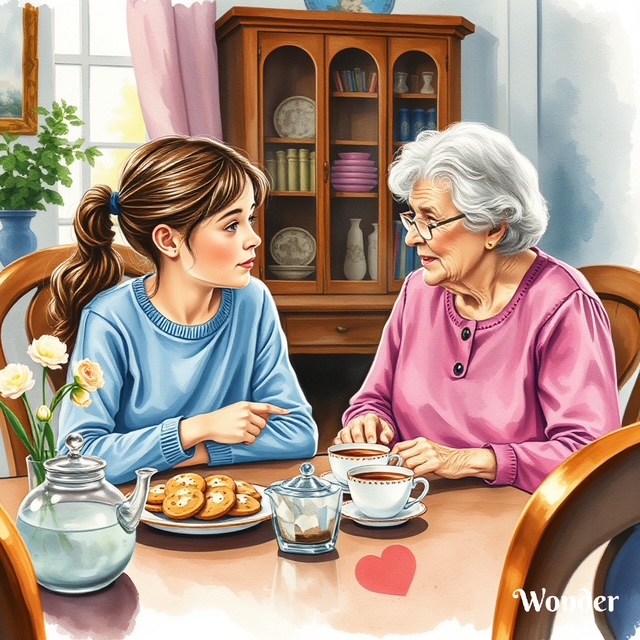
That evening, over cups of chamomile tea and homemade cookies, Liah found herself opening up to her grandmother. They sat in the cozy kitchen, where the fading sun cast warm shadows through the window.

Her grandma listened quietly, her gentle eyes encouraging Liah to continue.

Her grandma listened quietly.

She looked at her grandma, with tearful eyes.

Her grandmother reached across the table and held Liah’s hand.

Her grandmother got up and walked to an old wooden cabinet, pulling out a beautifully painted ceramic bowl.

Liah picked up the bowl, turning it in her hands.

Slowly, Liah began to write:

As she dropped each note in the bowl, something began to shift inside her – somehow Liah felt lighter, happier. She was surprised she had a lot of things to be happy about despite feeling sad.

Over the next few weeks, Liah found herself noticing small blessings – the scent of garden roses, a successful drawing, gardening with grandma, watching the orange fish in the pond. With each note she added, she realized something: her days weren’t as empty as she had thought. Good things had always been there – she just hadn’t been looking for them.

When it was time to leave, her grandmother insisted she take the bowl home.

Liah hugged her grandmother and promised she will continue the practice.

Liah had placed the gratitude bowl on her desk in her room. She continued to write gratitude notes every day. She began to appreciate little things around her and found there were many things she was grateful for, to feel happy for.

One evening, as her mother placed a cup of hot chocolate beside her, Liah hesitated for a moment, then picked up the gratitude bowl.

Her mother listened, intrigued, as Liah explained how the simple act of writing down little joys had changed her perspective.

To her surprise, her mother wanted to try it too. That night at dinner, her mother suggested they all share one good thing from their day. At first, it felt just words spoken out loud but soon, it became their favorite part of the evening. A quiet warmth spread their home, unspoken tensions softened, and they began to feel closer in ways they hadn’t before.  

Over time, Liah noticed a shift not just in how she felt, but in how others responded to her. She smiled more, and in turn, others smiled back. Conversations felt easier, friendships blossomed naturally, and she felt no longer trapped in the cycle of frustration. The gratitude practice that started as a simple habit had quietly reshaped her world.

In Liah’s case, her gratitude practice didn’t change her circumstances, but it changed how she experienced them. She became more aware of the love in her life, the small joys she had overlooked, and in doing so, found a sense of peace that had felt out of reach before.

Angels on the Redbud Tree

Morning Sky

The sky bursts into magnificent shades of orange and red, like flames dancing across the clouds. City buildings stand dark against the brilliant sunrise, their silhouettes sharp and strong. Against this stunning backdrop, Ann stands at her balcony with her precisely made coffee: two specific spoons of instant coffee from different brands, mixed until they create the perfect foam and topped with exactly half a cup of frothed almond milk. These careful rituals have become her anchor in a world that feels increasingly overwhelming.

Sparrow on a Redbud tree

On the Eastern Redbud tree overlooking her balcony, four of God’s messengers gather as they do every morning. Their daily ritual of watching over Ann has become their own sacred practice.

“Another beautiful sunrise,” Zeo, the yellow butterfly with blue stripes, whispers as she settles on a branch. “Each new day is a chance to share God’s love.”

“Ann seems more tired today,” Pip the sparrow observes gently, tilting his head. “I’ll sing an extra sweet song this morning – sometimes a single note of joy can lift a heavy heart.”

“We must be patient,” Luna, the grey moth, shares from her quiet corner. “Just as God waited for me to understand that beauty exists in darkness and light, Ann will find her way. Until then, we’ll keep her company in our own ways.”

Rio, the hummingbird, pauses between visiting flowers. “Every bloom I touch is a prayer,” she hums. “Each flower blossoms exactly as God created it – offering its unique gifts with joy, whether it’s color, fragrance, or sweet nectar. They don’t compete or compare; they simply bloom and share God’s love in their own perfect way.”

They watch as Ann puts on her noise-canceling headphones, blocking out their messages of hope. Yet they remain faithful to their purpose, these small angels in nature’s garden. Her golden lab, Tuffy, shares their mission in his own way. During their walks, while Ann hurries along with her headphones firmly in place, Tuffy feels the grass beneath his paws, catches the scent of morning dew, and notices every squirrel and butterfly. He never grows impatient with her hurried pace; he simply keeps offering these moments of joy, trusting she would notice when she’s ready.

Then one morning, halfway through their walk, Ann’s headphones die unexpectedly. The sudden silence feels like a shock. Frustrated, she removes them, and that’s when Pip sees his chance. He flies closer than usual, singing the song he’s been practicing just for her.

“Listen,” he seems to say, “God’s love is in every note.”

For the first time, Ann really hears the chorus of morning songs weaving through the air. She finds herself smiling, surprising herself. She notices the way sunlight filters through leaves, the gentle sway of trees in the morning breeze, the different pitches of birdsong.

The next day, though her headphones are fully charged, she finds herself removing them halfway through her walk, curious to hear the birds again. Walking along the trail, she finds comfort in the gentle presence of trees lining both sides of the path. Beneath their canopy, she feels her shoulders relaxing, her steps becoming lighter. She notices how the morning light filters through the leaves, creating patterns that dance with each breeze. Something about being among these quiet giants brings a peace she hadn’t known she was missing.

Each day, she starts looking forward to these moments of quiet discovery. What begins as a simple week-long experiment slowly changes something deep within her. Walking among the trees, she feels a subtle energy, as if their very presence is nurturing her spirit back to life.

Gradually, Ann’s carefully structured routines begin to soften. Her morning coffee ritual remains, but instead of immediately reaching for her headphones, she finds herself lingering on the balcony, watching the day unfold. From their branch on the Redbud tree, the four divine friends watch her transformation with joy.

“See how she notices the small things now,” Zeo flutters with excitement. “Just as God’s love appears in unexpected moments.”

“She’s learning to be still,” Luna observes. “Like how evening shadows teach us that rest is also part of God’s plan.”

“And look how she takes time with each flower now,” Rio adds, “finding sweetness in the present moment, just as God intended.”

Pip’s morning songs become Ann’s natural soundtrack, more soothing than any musical album. The hummingbird’s focused dance among her flowers shows her how to be present in each moment. Her evening walks with Tuffy change too. She begins to match his unhurried pace, letting him stop to investigate interesting smells, watching how he approaches each moment with fresh curiosity. She begins to appreciate Tuffy’s innocence, unconditional love and finding joy in the simplest moments. The setting sun paints the sky in soft colors, and sometimes Luna flutters past, reminding her that beauty exists in all forms, at all hours.

One morning, as Zeo makes her daily visit, Ann realizes something has shifted within her. The heavy feelings haven’t disappeared entirely – they’re part of her journey – but they no longer feel like walls closing in. Instead, like the butterfly that returns despite rain or wind, she has found a quiet persistence within herself.

“Each flower gives what it has,” she hears a voice deep within her heart. Each flower, each bird, each creature has its own way of sharing love with the world. No one better than another, each one perfect in its own right.

Flower

As days pass, Ann’s awareness deepens. She begins to realize that these creatures are more than just chance encounters – they’re messengers of divine love, each offering their unique gift. Zeo brings reminders of joy’s persistence, Pip shares songs of morning hope, Luna shows the beauty of quiet presence, and Rio demonstrates how to find sweetness in each moment.

She realizes something profound: she has never truly been alone. All along, she’s had these beautiful companions – the trees offering their steady presence, the birds sharing their songs, the flowers blooming faithfully, and even Luna appearing in the evening hours. She can talk to them, share with them, find comfort in their constant presence.

Together, they form a small choir of God’s love, and Ann has finally joined their song. Now, as she sits on her balcony each morning, coffee in hand and heart open to their presence, she hears the divine melody that has always been there, waiting for her to listen.

The Unseen Terror – A Child’s Experience of Abuse and Neglect

The sound of screaming reverberated through the walls of the house as 5 year old Annie ran up to the terrace cowered in terror, trying to stay as quiet and still as possible. She had seen it so many times before; her father’s rages and her mother’s desperate pleas for mercy. She had learned to make herself invisible, to pretend that it wasn’t happening. She had developed a survival mechanism of pretending that all was fine; where she would play on her own alone in the terrace, speaking and singing loudly to herself in the hopes of not hearing the abuse and cries. 

Annie would later stealthily walk her way back to her room and crawl up to her blanket to try to comfort herself to sleep, after what seemed like an eternity. The silence following the outburst was unnerving. The air felt thick and heavy, as if the room was filled with something that couldn’t be seen.

At times she found her father had left for work after the abuse and she had felt nothing but an overwhelming sense of relief.

All Annie needed was her parents to hold her, cuddle her, and let her know everything was fine and nothing was her fault. However, her parents were so deep in their own pain and anger, leaving Annie confused and scared. 

As Annie grew older, Annie found it increasingly difficult to trust people and form meaningful relationships. She was very selective in friends. She was constantly on guard. Her parents had taught her that love was equated with pain, so she kept most people at a distance. Annie’s past trauma had a lasting effect on her into adulthood. She struggled to manage her emotions, often feeling overwhelmed and powerless. She often felt like a victim, unable to control the events that were happening around her. The feelings of insecurity and mistrust followed her throughout her life, leaving her feeling isolated and alone.

The trauma experienced by children who witness physical abuse and experience neglect can be severe and long-lasting. It can lead to a range of long-term physical, psychological, and social problems. These can include, but are not limited to, physical bruises and injuries, anxiety, depression, post-traumatic stress disorder, and other forms of psychological trauma. Children who witness physical abuse may experience intense fear, guilt, and shame, as well as feelings of helplessness and powerlessness. They may feel that they are to blame for the abuse or that they should have been able to prevent it. They may also experience difficulties with trust, intimacy, and relationships. In extreme cases, they may even become abusers themselves.

Cognitive-behavioral therapy (CBT) is a common and effective treatment for adults with childhood trauma, particularly those who have witnessed abuse. CBT focuses on identifying and changing unhealthy thought patterns, behaviors, and reactions to stressful situations. It is often used in combination with other therapeutic interventions, such as psychodynamic and trauma-informed therapies. CBT can help individuals gain insight into their own behavior and learn skills to effectively cope with stress. In addition, CBT can help individuals to become more aware of their triggers and feelings, and how to manage them in a healthy way. CBT can also help individuals develop healthier relationships and communication skills.